

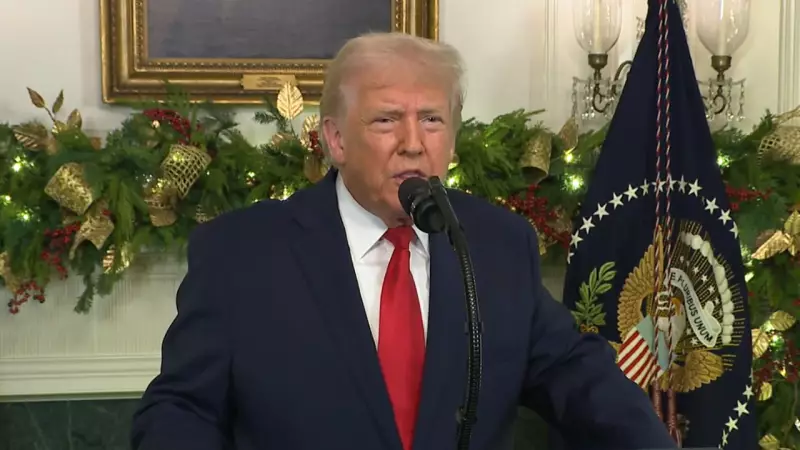
Iran has launched a formal diplomatic offensive at the United Nations, condemning what it calls "reckless and inflammatory" threats made by United States President Donald Trump. In a strongly-worded letter, Tehran has warned Washington that it will bear full responsibility for any escalation stemming from such statements.
A Formal Condemnation at the UN
In the letter dated January 2, Iran's Ambassador and Permanent Representative to the UN, Amir-Saeid Iravani, addressed both the UN Security Council and Secretary-General António Guterres. The document accuses the US President of openly threatening the use of force against a sovereign nation, which Tehran asserts is a clear breach of international law and the UN Charter.
The Iranian envoy specifically highlighted Trump's recent declaration on Truth Social, where the President stated, "We are locked and loaded and ready to go." Iravani argued that this rhetoric goes beyond mere words and constitutes "the incitement of violence, unrest, and terrorist acts within Iran." The letter frames these comments as an unlawful threat of force and a blatant interference in Iran's internal affairs.

Historical Grievances and Legal Arguments
Placing the current tension in a broader context, the Iranian letter recounts a history of perceived US aggression. It references the 1953 coup against Prime Minister Mohammad Mossadegh, US support for Saddam Hussein during the Iran-Iraq war, the 1988 downing of Iran Air Flight 655, the killing of Major General Qassem Soleimani, and decades of sanctions. It also mentions alleged joint US-Israeli attacks in June 2025 targeting civilian infrastructure.
On the legal front, Iran's complaint cites Articles 2(1), 2(4), and 2(7) of the UN Charter, stressing that international law strictly prohibits threats of force regardless of political justification. The letter asserts that encouraging unrest in another state is an "internationally wrongful act" and a grave violation of sovereignty.
Call for Action and Firm Rejection
Iran has called upon the UN Security Council to take a firm stand. The letter urges the body to "unequivocally and strongly condemn" the US statements and demand that America cease all threats of force. It concludes with a stark warning, reaffirming Iran's inherent right to defend its sovereignty and national security.
Iranian officials have uniformly rejected Trump's warnings. Foreign Minister Abbas Araghchi labeled the comments as "reckless and dangerous," maintaining that the ongoing protests within Iran are peaceful and economically motivated. Senior figures have cautioned that foreign intervention would cross Iran's security "red lines," potentially sparking wider regional instability.
The current wave of protests, triggered by economic hardship and a falling currency, is the most significant since the 2022 unrest following the death of Mahsa Amini in police custody. The diplomatic clash at the UN marks a serious escalation in rhetoric between the long-standing adversaries.

