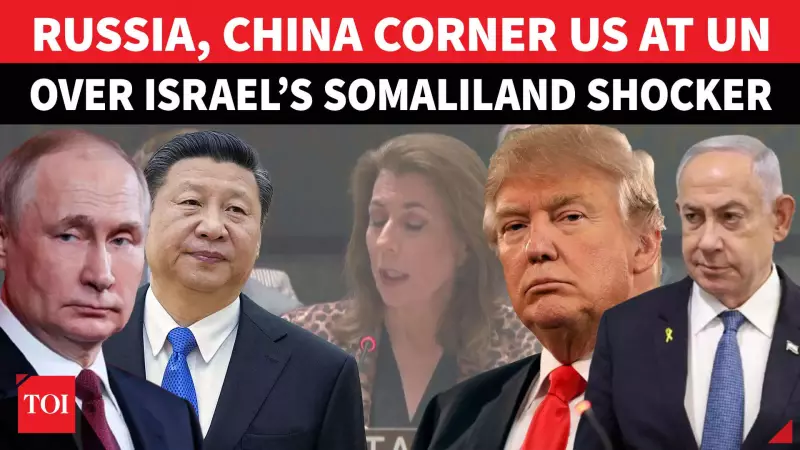
In a dramatic emergency session of the United Nations Security Council, the United States staunchly defended Israel's controversial decision to recognise the breakaway region of Somaliland. The high-stakes diplomatic confrontation, held on December 30, 2025, saw sharp divisions emerge over sovereignty and territorial integrity, with the American envoy drawing direct comparisons to other nations' recognition of a Palestinian state.
US Takes a Firm Stand at the UN
Deputy US Ambassador to the UN, Tammy Bruce, led the American defence, asserting that Israel, as a sovereign nation, possesses the full right to establish its own diplomatic relations. This argument formed the core of the US position, framing the recognition not as an act of aggression but as a legitimate exercise of national foreign policy. The American stance immediately set the tone for a heated debate, placing the recognition of Somaliland within the broader, often contentious, global discourse on statehood and self-determination.
Global Reactions and the Sovereignty Clash
The US defence did not go unchallenged. Several member states of the Security Council swiftly reiterated their unwavering support for Somalia's territorial integrity and sovereignty, expressing concern over any action perceived as undermining it. The United Kingdom explicitly reaffirmed its commitment to a unified Somalia, highlighting the deep international reservations about altering long-standing borders in the volatile Horn of Africa region.

In response to the criticism, Israel sought to downplay tensions. Official statements characterised the move as non-hostile and potentially a catalyst for future dialogue. Israeli diplomats presented the recognition as a constructive step intended to foster regional stability, suggesting it could open new channels for communication and cooperation rather than close them.
Broader Implications and the Path Forward
This emergency meeting underscores the complex geopolitical chessboard where local disputes become proxies for larger international rivalries. The American comparison to Palestinian state recognition adds a potent layer of political context, suggesting a tit-for-tat logic in diplomatic recognitions. The immediate consequence is a deepening of the rift within the international community regarding how to handle breakaway regions. While the direct fallout for Somalia and Somaliland remains to be seen, the UN Security Council session on December 30, 2025, has undoubtedly elevated the issue to a global diplomatic flashpoint, with significant implications for future policy in Africa and beyond.