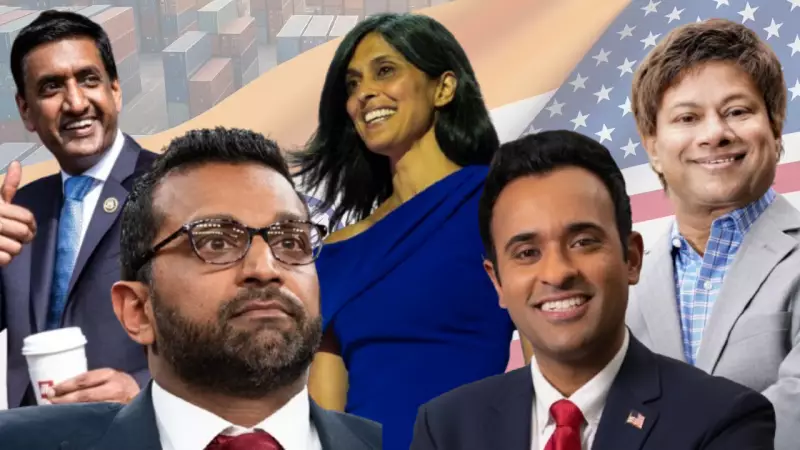
The landscape of American power is witnessing a significant shift. Historically dominated by European colonial narratives, the global conversation is now being shaped by individuals from nations once labeled as the 'third world'. In the United States, the influence of the Indian diaspora has moved from the periphery to the very center of political power. By 2025, this influence became impossible to ignore, heavily weighing on the policies and priorities of Donald Trump's second administration, which began in January 2024. A cohort of Indian-Americans held pivotal positions, riding the conservative wave, challenging it, or carving their own unique paths through a maze of achievement and controversy.
Key Players in the Political Arena
From the fallout of the Jeffrey Epstein files to the hardline 'America First' push on immigration, several Indian-American figures repeatedly found themselves at the heart of major national debates, making their presence and political power unequivocally clear.
Ro Khanna - The Consensus Catalyst

Democratic Congressman Ro Khanna emerged as a rare figure in Washington's polarized environment, adept at navigating between hardened ideological camps. His most visible moment in 2025 came during the renewed push to release the Epstein files in November. Khanna worked persistently behind the scenes, teaming up with libertarian Republican Thomas Massie to frame the issue not as a partisan weapon but as a fundamental test of Congressional transparency. This strategic framing allowed progressives to see it as accountability for elite abuse and conservatives as a stand against institutional cover-ups. Beyond this, he continued to build consensus on issues of civil liberties, tech oversight, and executive power.
Shri Thanedar - The Blunt Confronter
In stark contrast to subtle operators, Michigan Congressman Shri Thanedar chose a path of direct confrontation. He became the most vocal Democrat demanding impeachment-related accountability within the Trump administration. Thanedar openly targeted MAGA figures, calling for the removal of Secretary of War Pete Hegseth and urging Homeland Security Secretary Kristi Noem to resign. He repeatedly insisted that Donald Trump himself should face impeachment. By drafting articles, circulating resignation demands, and naming names in formal congressional records, he turned himself into Congress's most persistent irritant to the White House, forcing responses and creating uncomfortable moments for colleagues who preferred silence.
Cultural Battles and National Identity
Vivek Ramaswamy - The Ideological Provocateur
After his role co-leading the DOGE efficiency initiative with Elon Musk, Vivek Ramaswamy began laying the groundwork for a 2026 run for Ohio governor. The year also thrust him into cultural battles. When white nationalist Nick Fuentes used a racial slur against Second Lady Usha Vance, Ramaswamy publicly pushed back, arguing that race and ancestry do not define who is American. He articulated this in a New York Times op-ed, directly addressing extremist 'groypers' and stating that those perpetuating hate within the Republican Party do not deserve the title. His message centered on the American Dream being defined by belief and commitment, not bloodlines.
Usha Vance - The Second Lady in the Spotlight
Second Lady Usha Vance, the Hindu, Indian-origin wife of Vice President JD Vance, found herself an unwilling central figure in 2025. Debates on Christianity and American identity, triggered by her husband's remarks, placed her personal faith and security under scrutiny. The controversy intensified when she appeared at public events without her wedding ring, adding personal and political strain. The episode forced JD Vance to publicly affirm his love for his wife and step back from earlier comments about religious conversion, while Usha herself maintained her silence. Her presence has prompted a subtle rethinking of strict nationalist messaging within the MAGA movement.
Nalin Haley - The Next-Gen Nationalist

At just 24, Nalin Haley became one of the most polarizing young voices in the GOP. He went viral for his uncompromising stance against all immigration, calling for a complete ban on H-1B visas and rejecting dual citizenship. He dismissed concerns about Indians stuck in visa backlogs by stating they were "not stranded in their own country." Aligning more with JD Vance than Donald Trump, Haley insists immigrants must fully assimilate or leave, a stance further to the right than his mother, former UN Ambassador Nikki Haley, who supports merit-based immigration.
Policy Warriors and Unconventional Influencers
Pramila Jayapal - The Accountability Shadow
Congresswoman Pramila Jayapal used her role as ranking member of the House immigration subcommittee to hold power to account. She staged shadow hearings to expose the human cost of deportation policies, introduced the WISE Act to protect immigrant survivors of violence, and denounced denaturalization quotas. Drawing on her own 17-year journey to citizenship, she challenged narratives that legal immigration is easy, calling ICE a "terrorist force" and co-introducing legislation to improve detention conditions.
Raja Krishnamoorthi - The H-1B Advocate
While identity politics swirled, Congressman Raja Krishnamoorthi focused squarely on policy. He became a leading voice pushing for Indian representation through economic arguments, warning that shutting out skilled workers would harm the US economy. He reintroduced the HIRE Act, designed to double the annual H-1B visa cap from 65,000 to 130,000. This move was a direct counter to the Trump administration's proposed fee hikes and visa lottery overhaul.
Asha Jadeja Motwani - The Backchannel Negotiator
Silicon Valley venture capitalist Asha Jadeja Motwani occupied an unconventional but powerful space—unelected, unappointed, yet influential. She claimed to use her personal access, including golf games with Trump, to soften the administration's hardline stance on H-1B visas. Facing bipartisan criticism for backing nationalist rhetoric while advocating for Indian talent, she argued that being proud of one's culture is essential for coexistence, often comparing it to Hindu identity in India.
Zohran Mamdani - The Socialist Disruptor
New York's Muslim mayor-elect, Zohran Mamdani, openly called himself a "nepo baby" while fusing hard-left economics with street-level organizing. His pro-Palestinian stance and evolution from 'defund-the-police' rhetoric to engaging with a pro-Israel police commissioner made him a complex figure. Notably, Donald Trump himself criticized a right-wing attack labeling Mamdani a "jihadi," in an unusual moment of defense from the White House.
Kash Patel - The Controversial FBI Director
The most symbolically significant appointment came in February 2025, when Kash Patel became the ninth director of the FBI by a narrow 51-49 vote, marking him as the first Indian-origin head of the agency. He pledged to rebuild trust and increase transparency. However, his tenure was immediately marred by controversy. He faced backlash for using an FBI jet for personal trips to visit his girlfriend, country singer Alexis Wilkins, and for assigning FBI SWAT agents for her protection. Internally, agents questioned his hasty decisions on sensitive cases. Most notably, after previously calling for full transparency on the Epstein files, as director he paid little attention to them, leading to accusations of a cover-up on a matter of national security.
The collective story of these ten individuals in 2025 underscores a profound transformation. The Indian-American community is no longer just a demographic footnote but a dynamic, sometimes contradictory, force actively writing chapters of American policy, identity, and power.