

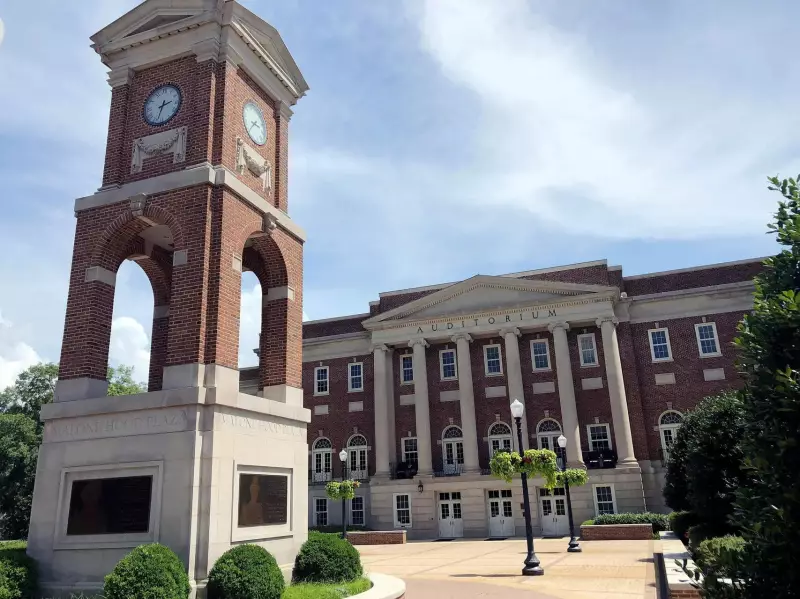
A coalition of students and faculty members from public universities across Alabama has approached a federal appeals court, seeking to halt a state law that imposes significant restrictions on diversity, equity, and inclusion (DEI) initiatives. The law also sets boundaries on how topics related to race and gender can be addressed in campus classrooms.
The Core of the Controversial Legislation
Enacted in October 2024, the Alabama law prohibits public schools and universities from using state funds for any programs or curricula that promote what Republican legislators have termed "divisive concepts." Furthermore, the statute explicitly forbids instructors from encouraging students to feel guilt, anguish, or personal responsibility based on their race, religion, or gender identity.
This move by Alabama is not an isolated incident. It forms part of a wider campaign led by Republican lawmakers in multiple states to curtail DEI programs within higher education. Proponents assert that such policies bring back neutrality to public institutions. Critics, however, argue they create a climate of fear and uncertainty, reshaping academic discourse through ambiguously worded restrictions.

A Legal Battle Over Classroom Content
The appeal follows an earlier ruling by United States District Judge David Proctor, who allowed the law to remain in effect. Judge Proctor determined that a professor's academic freedom does not supersede a public university's authority to decide classroom content. He clarified that the law does not ban all discussions concerning race or gender. It allows instructional material that includes the listed concepts, provided the presentation is objective and without endorsement. This ruling is now the focal point of the current appeal.
The legal challenge emerges close on the heels of a July mandate from the United States Department of Justice, which laid out similar expectations for public schools nationwide. Reports from the Associated Press indicate that by 2025, the cumulative impact has involved the shutdown of student affinity groups, alterations to course material, and the suspension of some faculty members.
Vagueness of the Law and Its Chilling Effect
Attorneys for the students and professors contend that the law's wording is excessively open to interpretation. Antonio Ingram, a lawyer with the Legal Defense Fund representing the plaintiffs, told AP that the statute fails to clearly define what constitutes "endorsement." This lack of clarity, he says, leaves instructors vulnerable to complaints and investigations.
"Truth becomes what the state says versus what independent researchers and theorists and academics have spent decades crafting," Ingram stated. He warned that if the law stands, universities risk transforming into "mouthpieces of the state" instead of bastions of independent inquiry.
Real-World Impact: A Professor's Rewritten Syllabus
The law's influence is already palpable inside classrooms. Dana Patton, a political science professor at the University of Alabama in Tuscaloosa and one of the plaintiffs, testified to its immediate effect. She informed AP that she has modified sections of a curriculum she has taught for decades due to the new restrictions.
"We feel very constrained by the vagueness of the law," Patton explained, noting that students might misconstrue a lesson as endorsement rather than critical analysis. Last year, she faced complaints from five students who alleged her curriculum for an interdisciplinary honours programme conflicted with the statute. Although Patton maintains she has always presented multiple viewpoints, the complaints amplified her concerns, leading to the removal of some material from her syllabus.
"It's just safer to not teach certain things and to avoid potential repercussions or complaints being filed," she said, summarizing the cautious atmosphere the law has engendered.
What the Appeal Represents for the Future
The federal appeals court is now tasked with a critical decision: determining whether the law's restrictions violate constitutional protections or whether states retain broad powers to shape instruction in public universities. While the ruling will address legal technicalities, its consequences are already being felt on the ground.

For the academic community in Alabama, the anxiety extends beyond what is explicitly prohibited to what gradually vanishes from discourse due to self-censorship. As the appeal progresses, its verdict will play a decisive role in determining whether these changes are a temporary reaction to legal ambiguity or a permanent transformation of public higher education in the state.





