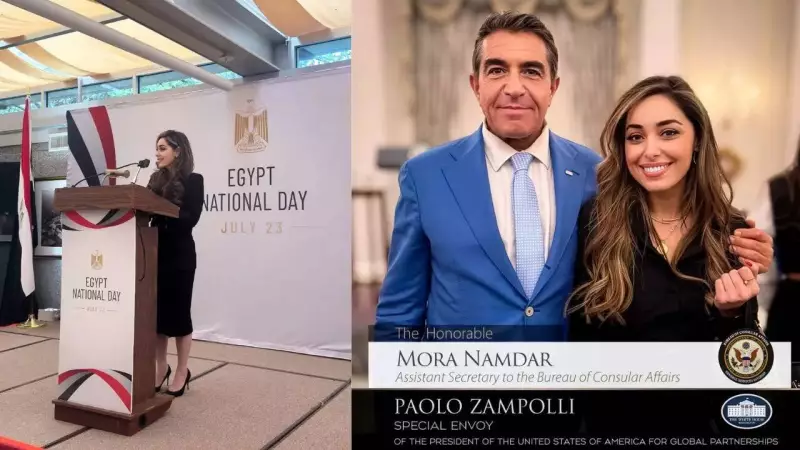
In the evolving political landscape of Donald Trump's Washington, a new logic is taking hold. Governance increasingly operates through loyalty, ideological alignment, and proximity to power, often bypassing traditional institutional pipelines. The latest embodiment of this shift is Mora Namdar, a figure whose civilian background is turning heads as she steps into one of the most powerful roles in the US State Department.
From Texas Salons to Global Visa Authority
Mora Namdar is now the Assistant Secretary of State for Consular Affairs, confirmed by the Senate in December 2025. This office holds immense, quiet power, deciding who enters the United States, who is turned away, and whose legal presence can be revoked. It oversees global visa adjudication, passport issuance, and consular enforcement.
What makes her profile striking is her parallel career as a business owner. Namdar is the founder of Bam Beauty Bar, a boutique beauty salon chain with outlets in Dallas, Fort Worth, and Plano, Texas. In an arena traditionally led by career diplomats, her business ownership signals a distinct departure from the norm, a hallmark of the current administration's preference for figures outside established bureaucratic channels.

A Legal Mind with Project 2025 Links
Namdar is far from an outsider to government or law. She is an Iranian-American attorney, licensed to practice in Texas and Washington, D.C. Before her full-time return to government service, she ran Namdar Law PLLC, a boutique firm focusing on business, government, and international legal matters.
She also has direct experience in her current role, having served as the acting Assistant Secretary of State for Consular Affairs from December 22, 2020, to January 20, 2021, during Trump's first term. She later held a senior leadership role in the Bureau of Near Eastern Affairs, shaping US policy on the Middle East and North Africa.
Critically, her appointment connects to Project 2025, the comprehensive conservative blueprint guiding Trump's second-term staffing. Namdar contributed to the project, focusing on restructuring the US Agency for Global Media. Her placement in Consular Affairs positions a Project 2025 contributor inside a bureau that directly translates policy into administrative action, controlling the flow of people across US borders.
The New Washington: Performance, Proximity, and Ideology
Namdar's elevation fits a clear pattern in Trump's Washington, which increasingly resembles court politics. Recent episodes—like a former Fox News host becoming Secretary of Defence, or sensitive military plans leaking into Signal chats—are no longer shocking anomalies but descriptions of the system.
Power circulates through proximity. Administration becomes performance-adjacent. The bureaucracy is tasked with executing a clear ideology. In this environment, visibility and alignment often replace long tenure and traditional pedigree.
While flashy appointments grab headlines, it is often in quieter roles like Consular Affairs where significant control is exerted. Through discretion, paperwork, and procedural delay, this office fundamentally shapes migration, opportunity, and international diplomacy. Mora Namdar, the lawyer-entrepreneur in her late 30s, now operates this powerful lever, her story reflecting the new rules of American governance.