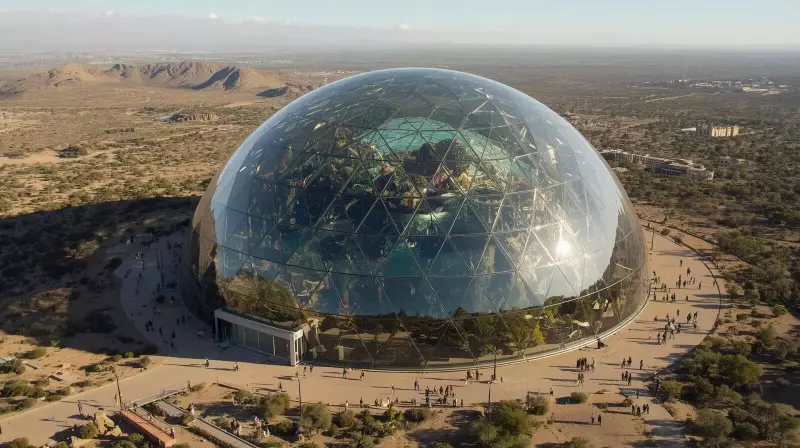
Biosphere 2: Arizona's Sealed Earth Experiment Evolves from Isolation to Environmental Research
In the arid expanse of the Arizona desert, far from urban centers and agricultural lands, stands a remarkable glass-enclosed structure that once captured global imagination. Built to test a bold and uncertain hypothesis, this facility known as Biosphere 2 was designed to explore whether humans could survive in a completely self-contained environment without external air, food, or assistance. Originally conceived as a sealed research facility mirroring Earth's living systems, its journey has transformed from a high-profile isolation experiment to a vital center for environmental science.
A Closed World Built Under Glass
Biosphere 2 spans an impressive 3.14 acres, encapsulated under more than 7 million cubic feet of sealed glass panels. A welded stainless steel liner beneath the structure prevents any exchange with the surrounding desert soil, ensuring complete isolation from the external environment. Inside, the space is meticulously divided into several distinct biomes, including a lush tropical rainforest, a miniature ocean with coral reefs, mangrove wetlands, savanna grasslands, and a fog desert. These interconnected environments demonstrate how changes in one biome can ripple through others, creating a dynamic microcosm of planetary systems.
As a human-made ecosystem, Biosphere 2 differs fundamentally from natural environments. Scientists can precisely measure and adjust variables such as temperature, humidity, and gas levels, offering unprecedented control over experimental conditions. This level of manipulation allows researchers to observe ecological processes that are typically entangled and difficult to isolate in the open world, providing unique insights into Earth's complex systems.

The Pioneering Human Experiment
The most famous chapter in Biosphere 2's history began in 1991, when eight participants entered the sealed enclosure for a groundbreaking two-year mission. These individuals grew their own food, recycled water, and lived entirely within the closed system, with no outside supplies permitted. The experiment aimed not for comfort but for understanding the intricate interactions between air, water, soil, and life in a self-sustaining environment.
Despite its ambitious goals, the mission encountered significant challenges. Oxygen levels unexpectedly dropped, creating health concerns for the inhabitants. Food production proved more difficult than anticipated, leading to nutritional shortages. Personal tensions among the crew became public, highlighting the psychological strains of prolonged isolation. Nevertheless, the experiment demonstrated the remarkable complexity and fragility of closed ecosystems, revealing how little margin for error exists when life support systems must function without backup or external intervention.
Evolution of Ownership and Scientific Focus
The land hosting Biosphere 2 has a rich history dating back to the 1800s, when it formed part of the Samaniego CDO Ranch. After serving as a conference center, the property was purchased in the 1980s by Space Biospheres Ventures, which constructed the current glass-enclosed facility. Ownership shifted in the mid-1990s to Decisions Investments Corporation, followed by management under Columbia University, during which research priorities moved toward plant science and carbon dioxide studies. Classrooms and student housing were added to accommodate academic activities.
In 2011, the University of Arizona assumed ownership and continues to operate the facility today. Under university stewardship, Biosphere 2 has transitioned from its original isolation-focused mission to become a hub for long-term environmental research, reflecting broader scientific priorities around climate change and ecosystem dynamics.
Contemporary Research and Educational Mission
Today, Biosphere 2 serves as a controlled laboratory for studying Earth's systems under meticulously managed conditions. One of its major installations is the Landscape Evolution Observatory, where scientists investigate how soil, water, and rock interact over extended periods. These experiments aim to deepen understanding of erosion patterns, water cycles, and the impacts of climate change on terrestrial processes.

Funding for ongoing research comes from a combination of private donations and public grants, including support from the National Science Foundation. Beyond pure research, the site plays a significant educational role, hosting students, researchers, and visitors from around the world who come to learn about environmental science and sustainability.
Enduring Legacy and Public Fascination
Since its opening, more than three million people have visited Biosphere 2, often arriving with expectations of exploring a relic of a failed dream. Instead, they discover a fully operational laboratory that continues to evolve and contribute to scientific knowledge. The glass walls remain sealed, preserving the integrity of ongoing experiments, while inside, ecosystems shift in small, measured ways under careful observation.
The surrounding desert remains dry and unchanged, providing a stark contrast to the controlled environments within. While Biosphere 2 no longer primarily promises answers about space colonization, it offers something perhaps more valuable: a place to observe Earth's behavior under conditions where variables can be isolated and studied with precision. It stands as a testament to human curiosity and our enduring quest to understand the planet we inhabit.