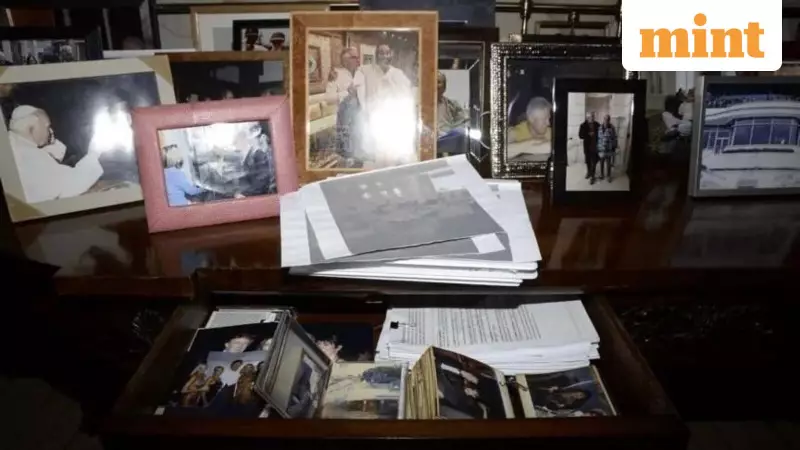
The US Department of Justice (DOJ) found itself in a storm of controversy over the weekend after it temporarily removed a photograph of former President Donald Trump from the trove of newly released Jeffrey Epstein-related documents. The image, showing Trump and his wife Melania with the convicted sex offender and his associate Ghislaine Maxwell, was taken down and then re-uploaded on Sunday, sparking allegations of a political 'cover-up'.
Photo Removal Sparks Online Fury and Accusations
The DOJ initially published thousands of files linked to the Epstein case on Friday. However, file number 468, which contained the printed photograph from Epstein's possession, was promptly removed. This action ignited immediate and heavy criticism across social media platforms, with users accusing the department of attempting to shield powerful figures.
Netizens were quick to voice their anger. One user on X sarcastically commented, "Sorry we got caught," while another demanded complete transparency from the government. "The more you attempt to hide the perpetrators of these heinous acts, the more you expose your partiality. Justice is meant to be blind, not partisan," the user wrote. A third critic highlighted the perceived incompetence, stating, "I don't know what's more worrying, that attempt at corruption, or the incompetence at carrying it out."

DOJ's Explanation and Mounting Political Pressure
Facing intense scrutiny, the DOJ issued a statement on Sunday explaining its actions. In a social media post, the department said the image was flagged by the Southern District of New York for "potential further action to protect victims." It was taken down "out of an abundance of caution" and re-uploaded after a review found "no evidence that any Epstein victims are depicted in the photograph." The photo was reposted without any alteration.
The controversy, however, extended beyond this single image. Reports emerged that between 15 to 16 files in total were taken down from the DOJ website shortly after the initial release. This fueled further suspicion among critics and lawmakers.
Democrats on the House Oversight Committee joined the public outcry, directly questioning the nature of the removals. Their demand was clear: "What else is being covered up? We need transparency for the American public."
Official Defense and the Redaction Controversy
Deputy Attorney General Todd Blanche became the DOJ's public face to address the growing scandal. Appearing on NBC's 'Meet the Press' on Sunday, Blanche defended the department's actions. He clarified that the removal of the Trump photo was not related to the former president but was done because the image showed photographs of women in the background.
"We learned after releasing that photograph that there were concerns about those women... So we pulled that photo down. It has nothing to do with President Trump," Blanche stated, adding that victim advocacy groups had raised the concerns.
Another major point of contention was the extensive redactions found throughout the newly released Epstein documents. Notably, a 119-page Grand Jury document was initially released in a fully redacted form, drawing sharp criticism for violating the spirit of the Epstein Files Transparency Act, which mandates full disclosure.
Pennsylvania Representative Summer Lee expressed a common sentiment, calling the redactions "an absolute mockery of the survivors of Epstein’s abuse and the American people." In response to this backlash, the DOJ also released a version of the same Grand Jury document on Sunday with what it termed "minimal redactions." The department pledged to continue reviewing documents with caution for victims and their families.
The episode has cast a spotlight on the challenges of balancing transparency with victim privacy in one of the most high-profile criminal cases involving global elites, continuing to raise questions about the completeness of the investigative process.