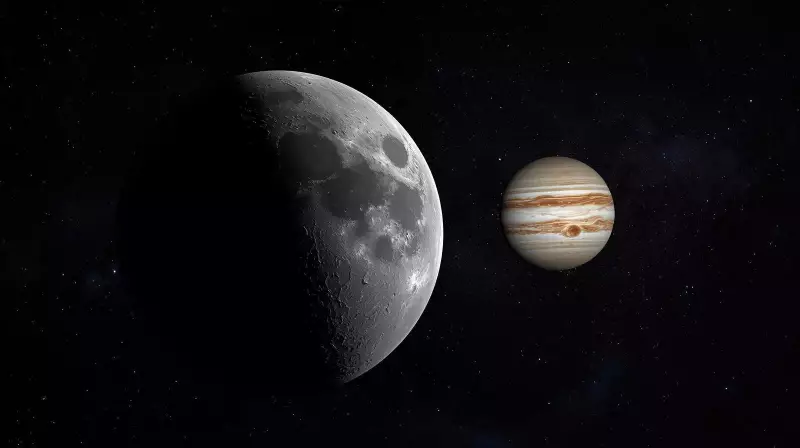
For decades, Europa, one of Jupiter's icy moons, has been a tantalising candidate in the search for extraterrestrial life. While Mars often grabs headlines and Saturn's moon Enceladus shows strange plumes, Europa has quietly orbited with the promise of a vast, hidden ocean beneath its frozen crust. However, a groundbreaking new study published in the journal Nature Communications has cast fresh doubt on this optimistic vision, suggesting the subsurface sea may be far less hospitable than previously imagined.
A Deep but Dormant Ocean
The core of the new research shifts focus from Europa's bright, cracked ice shell to the rocky seafloor beneath. Scientists have long believed that for life to emerge and persist, an ocean needs more than just water—it requires a continuous source of energy. On Earth, deep-sea hydrothermal vents provide heat and chemicals that fuel entire ecosystems. The study's models of Europa's interior present a different picture: a largely still and geologically quiet seafloor.
Researchers analysed how heat moves through the moon and the effects of its orbital stress. Unlike some other active moons, Europa's path around Jupiter is relatively stable. This means it experiences weaker tidal forces—the gravitational pulling and squeezing that can generate internal heat. The findings indicate that any primordial heat from the moon's formation has likely dissipated over billions of years. The result is an ocean that, while probably deep and ancient, may lack active vents, steady heat flow, and the chemical recycling thought crucial for biology.

What This Means for the Search for Life
This discovery does not completely slam the door on life existing on Europa, but it significantly narrows the window of possibility. Life as we understand it struggles in environments where nothing changes. Without ongoing geological activity to circulate nutrients and provide energy, Europa's ocean could be a quiet, stagnant place.
The study suggests the moon may be a world with water, depth, and time, yet missing the vital spark of sustained energy. Life would need to survive on extremely limited resources, perhaps in small, isolated chemical pockets. Conditions might have been different in the distant past, but the present outlook appears calm to the point of being barren.
All Eyes on Future Missions
The upcoming NASA Europa Clipper mission is now poised to provide critical real-world data to test these models. While the spacecraft will not drill through the ice, it will perform detailed reconnaissance. It will map the surface in unprecedented detail, measure the thickness of the ice shell, and study how the moon flexes under Jupiter's gravity.
These measurements are key. They could reveal whether the ice shell moves independently, suggesting interaction with the liquid below, or whether there is any evidence of material exchange between the ocean and the rocky mantle. The answers may confirm the quiet, still Europa depicted in the new study. Yet, even that knowledge is valuable. Space exploration is not solely about discovering life; it is also about understanding the conditions that make life possible—or impossible. For now, Europa continues to drift in silent mystery, awaiting a closer look from human ingenuity.