

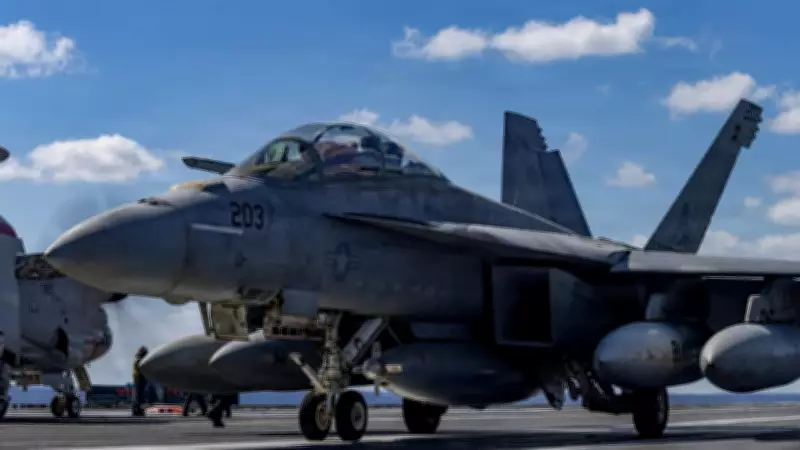
Inside the F/A-18 Super Hornet: The Backbone of the US Navy's Air War in Iran
The Boeing F/A-18E/F Super Hornet continues to serve as the cornerstone of the United States Navy's carrier air wings, standing as one of the most battle-proven multirole fighters in contemporary military aviation. National security analyst Steve Balestrieri has recently assessed the aircraft's pivotal role in modern warfare, highlighting the Super Hornet as the centerpiece of the Navy's strike packages during Operation Epic Fury. This ongoing air campaign is specifically targeting Iranian military infrastructure.
As of March 13, three US carrier strike groups operating in the region are deploying Super Hornets alongside F-35C Lightning II stealth fighters and EA-18G Growler electronic attack aircraft. Their mission is to dismantle nuclear facilities and missile infrastructure linked to the Islamic Revolutionary Guard Corps, according to a report by the US agency 19fortyfive. Despite the emergence of fifth-generation stealth aircraft, analysts emphasize that the Super Hornet provides the US Navy with a reliable and cost-effective strike platform, capable of delivering sustained firepower well into the 2040s.
Origin and Historical Significance
The Super Hornet entered operational service with the US Navy in 1999, succeeding the earlier McDonnell Douglas F/A-18 Hornet design. The F/A-18 Hornet is a US-made, twin-engine, supersonic multirole combat aircraft engineered to execute both air-to-air and air-to-ground missions, with the "F/A" designation denoting its dual fighter and attack roles.

Its inaugural combat deployment occurred during the Iraq conflict. On November 6, 2002, two F/A-18E Super Hornets conducted a "Response Option" strike as part of Operation Southern Watch. They targeted surface-to-air missile launchers at Al Kut and a command bunker at Tallil Air Base in Iraq, marking the first combat use of a 2,000-pound JDAM bomb by a Super Hornet.
In 2017, the aircraft showcased its air-to-air prowess when a US Navy Super Hornet shot down a Sukhoi Su-22 operated by the Syrian Air Force after it bombed positions held by the Syrian Democratic Forces. This engagement was the first instance since 1991 of a US fighter aircraft downing an enemy plane in combat.
Super Hornets have also been integral to recent maritime security operations in the Middle East. In December 2023, aircraft from the USS Dwight D Eisenhower carrier strike group intercepted multiple aerial threats launched by the Houthis in Yemen, destroying 12 attack drones, three anti-ship missiles, and two cruise missiles in the southern Red Sea, per US military reports. In January 2024, US, British, and allied aircraft executed coordinated strikes on Houthi targets across Yemen, hitting dozens of sites with precision-guided munitions.
Boeing, which acquired McDonnell Douglas in 1997, now manufactures the newer F/A-18 Super Hornet variant, proudly declaring it the "backbone of carrier air wings."
Super Hornet's Role in Operation Epic Fury
The Super Hornet has once again taken center stage in the ongoing air campaign against Iran. Operation Epic Fury, initiated on February 28, represents the culmination of decades of planning by the United States Central Command and its air components against Iranian forces.
The operation focuses on three primary objectives:
- Suppressing Iran's air defence network using Growler electronic warfare aircraft and F-35 stealth fighters
- Destroying nuclear enrichment and weapons infrastructure
- Degrading the military capabilities of the Islamic Revolutionary Guard Corps, including missile launch systems and naval forces
US War Secretary Pete Hegseth stated that the mission aims to neutralize Iran's offensive missile capabilities and prevent the country from acquiring nuclear weapons. Initially reliant on Tomahawk cruise missiles, the campaign has increasingly shifted to carrier-based aircraft as stockpiles were depleted.
Each carrier air wing typically includes:
- Three squadrons of 12 Super Hornets
- One squadron of F-35C stealth fighters
- One squadron of EA-18G Growler electronic warfare aircraft
Collectively, these aircraft have reportedly struck thousands of Iranian targets since the campaign's inception.

Engineering and Performance Capabilities
The Super Hornet is powered by two General Electric F414-GE-400 turbofan engines, designed for rapid maintenance and removable by a four-person crew in approximately 20 minutes. The Boeing F/A-18E/F Super Hornet is engineered to carry a diverse arsenal of weapons.
For air-to-air combat, it can deploy missiles such as the AIM-120 AMRAAM, AIM-9 Sidewinder, and AIM-7 Sparrow. In strike operations, it utilizes missiles like the AGM-65 Maverick, AGM-84H/K SLAM-ER, AGM-88 HARM, AGM-158 JASSM, and the AGM-154 Joint Standoff Weapon to target ground assets, radar systems, and fortified infrastructure. Additionally, the aircraft can carry various bombs, including Joint Direct Attack Munition precision-guided bombs, the Paveway series of laser-guided bombs, and Mark 80 series bombs.
Latest Evolutions: Block III Advancements
The latest modernization, known as the Block III advancements, represents the most advanced version of the Super Hornet. Major upgrades include:
- Conformal Fuel Tanks (CFTs) that increase range without using external pylons
- A 10,000-hour service life, extended from 6,000 hours
- A 10×19-inch touchscreen cockpit display replacing older analog interfaces
- Improved sensor fusion and networking capabilities
The aircraft also features the Tactical Targeting Network Technology (TTNT) system, enabling faster and more secure data sharing between aircraft. Other enhancements include a reduced radar cross-section and augmented computing power through a Distributed Targeting Processor Network, allowing pilots to process battlefield information more efficiently.
Super Hornet and Growler Synergy
The Super Hornet operates in tandem with its electronic warfare counterpart, the EA-18G Growler, forming a complementary carrier-based strike team. While the Super Hornet executes kinetic missions such as air-to-air combat and precision strikes, the Growler performs electronic attack operations designed to disrupt enemy radar systems, communications networks, and air defence sensors.
Despite the introduction of stealth aircraft like the F-35C Lightning II, the Super Hornet remains one of the most versatile and cost-effective fighters in the US military inventory. Service life extension programs and modernization upgrades are projected to keep the aircraft operational into the 2040s, when the next-generation F/A-XX program fighter is anticipated to enter service.





