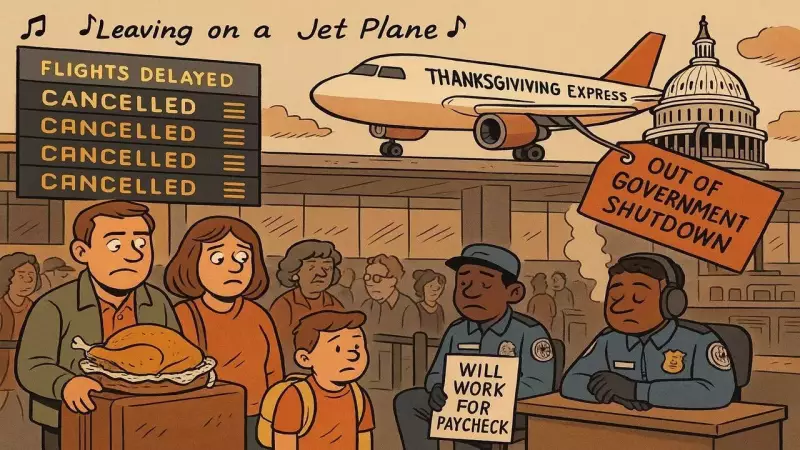
The familiar lyrics of John Denver's "Leaving on a Jet Plane" have taken on a bitter irony in 2025 as the United States faces unprecedented travel chaos. The Federal Aviation Administration (FAA) has mandated a 10% reduction in flights across 40 major American airports, creating the worst pre-holiday travel disruption in decades.
Political Gridlock Grounds Flights
This extraordinary measure stems from the longest government shutdown in US history, now stretching into its second month. The shutdown began on October 1 after budget negotiations between President Donald Trump and Congress completely collapsed. The political deadlock centers on immigration funding disputes, federal spending limits, and proposed rollbacks of green energy subsidies that Democrats refused to approve.
The cascading effects have paralyzed crucial public services, with over 800,000 federal employees either furloughed or working without pay. Among those essential workers are the nation's air traffic controllers and Transportation Security Administration (TSA) officers - the very professionals responsible for keeping aircraft safely separated in the skies and passengers secure in airports.

Safety Concerns Trigger Emergency Action
By early November, alarming safety data prompted urgent action. Internal FAA reports documented increasing fatigue among air traffic controllers, while voluntary safety submissions from pilots highlighted concerns about slower response times and communication errors. Faced with mounting evidence of system strain, Transportation Secretary Sean P. Duffy and FAA chief Bryan Bedford made the dramatic decision to reduce flight volumes before a major incident occurred.
The emergency directive ordered all major carriers - including United, Delta, American, and Southwest - to cut domestic flight schedules by 10%. The reductions were phased in gradually, starting at 4% and reaching the full 10% by mid-November. The affected airports represent the nation's busiest travel hubs, including Atlanta, Los Angeles, New York, Chicago, Dallas, and Miami.
Travel Chaos During Peak Season
The timing couldn't be worse for American travelers. Thanksgiving week typically sees over 55 million people traveling across the country, making it the single largest travel period annually. While long-haul international routes remain largely unaffected, smaller regional flights have borne the brunt of cancellations.
Airlines received just 48 hours to revise schedules, reassign crews, and process passenger refunds. The result has been massive disruption, with flight-tracking services recording more than 3,000 cancellations nationwide since the order took effect. Airlines estimate the capacity reduction could cost them over $400 million in lost revenue, with hotels, car rental companies, and airport restaurants facing similar financial hits.
The human impact extends beyond inconvenience. Air traffic controllers, legally prohibited from striking, continue working ten-hour shifts without pay. Many TSA officers have taken second jobs to make ends meet while reporting for duty understaffed. The FAA's training academy in Oklahoma City has suspended new recruit intakes, exacerbating an existing shortage of approximately 3,000 controllers nationwide.
As one aviation analyst starkly warned, "You can't run a 24/7 airspace system with exhausted people and no paychecks." The FAA maintains that flying remains safe, but this assurance grows increasingly tenuous as fatigue accumulates and morale plummets among critical safety personnel.
What Travelers Need to Know
Passengers facing Thanksgiving travel should prepare for significant challenges:

- Refund rights: Airlines must provide full cash refunds for cancelled flights but aren't obligated to cover accommodation or meal costs
- Extended delays: Expect longer TSA security lines as unpaid officers continue working, often with reduced staffing
- Strategic planning: Early-morning or nonstop flights are less likely to be affected by cancellations
- Proactive monitoring: Travelers should closely watch airline applications and prepare backup transportation plans
The FAA describes the flight reductions as temporary, to be lifted once the government shutdown concludes. However, aviation experts caution that even with immediate resolution, restoring full flight schedules and rebuilding employee morale will require weeks, if not months. For now, America's skies remain unusually empty - not due to weather or conflict, but because a divided government failed to pass a basic budget.