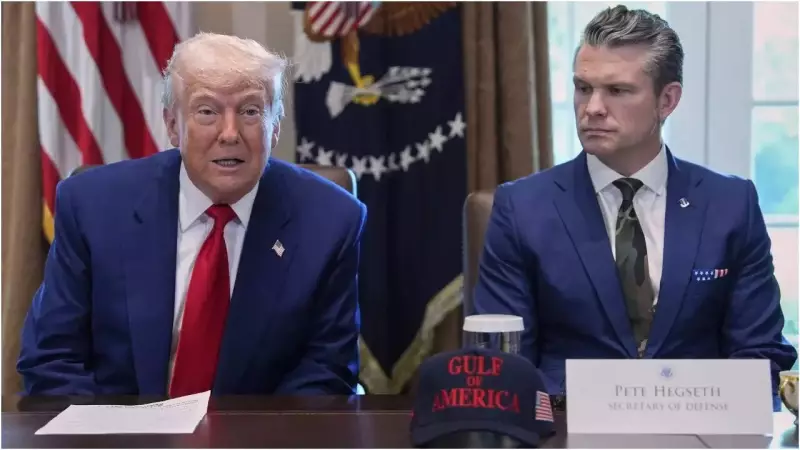
In a dramatic shift, key Republican figures who once strongly supported Pete Hegseth are now leading a serious internal revolt against him. This marks the most significant challenge to a cabinet official in Donald Trump's second term as President.
The Lethal Boat Strike That Broke Republican Patience
The immediate trigger for this political firestorm was a US military operation in Latin America on 2 September. The mission targeted a vessel suspected of drug smuggling. An initial missile strike killed most people on board. However, two individuals survived, clinging to the wreckage. In a controversial decision, a second strike was ordered minutes later, which resulted in the deaths of those two survivors.
When Pentagon officials briefed Republican lawmakers on the incident, they failed to provide clear answers. The officials arrived without legal counsel, could not adequately explain the legal framework used to authorise the second strike, and struggled to outline the chain of command behind the critical decision. For many in the GOP, this lack of transparency was more alarming than the operation itself. The sentiment among lawmakers was blunt: they felt they could not get straight answers from their own Defence Secretary.

A Growing Pattern of Secrecy and Erratic Leadership
Republican frustration with Hegseth, however, predates the September strike. For months, members of key congressional committees have privately complained about his leadership style. Their grievances include Hegseth cutting Congress out of major decisions, ignoring oversight requests, rejecting established consultation norms, and centralising decision-making within a small inner circle at the Pentagon.
The boat strike turned this simmering irritation into a full-blown, public confrontation. Senior Republicans who previously defended Hegseth now openly state that their confidence in his leadership has seriously eroded. Others now refuse to publicly confirm their support for him, a clear signal in Washington that his political backing is rapidly slipping. The emerging pattern, as seen by Congress, is not of one bad decision but of a Defence Secretary who treats congressional oversight as optional.
The Bradley Question and Escalating Political Danger
The controversy now also focuses on Admiral Frank Bradley, the commander who oversaw the lethal September operation. He is expected to defend the second strike by arguing the survivors remained legitimate targets, as they could have retrieved narcotics or alerted accomplices.
Republican investigators are demanding to know if Admiral Bradley acted on his own or followed a verbal directive to ensure "no survivors." They are calling for the release of full surveillance video and all communication logs to determine the precise sequence of events. A major concern is whether the Pentagon's public explanations will match the actual footage. If inconsistencies are found, the political damage could quickly expand from Admiral Bradley to Secretary Hegseth, and potentially to the White House itself.
Why Republicans Are Acting Now
The current backlash is driven by three urgent concerns gripping Republican lawmakers. First is legal exposure. If the second strike is later judged unlawful, Congress cannot afford to be seen as having ignored it. Some Republicans want to position themselves as correcting the Pentagon's course, not enabling it.
Second is operational credibility. A Defence Secretary who cannot clearly explain a major mission undermines congressional and public support for ongoing military operations, not just in Latin America but globally. Finally, there is the need for political insulation. Republicans are acutely aware that any major scandal could eventually extend to President Trump himself. Distancing themselves early from a problematic official is a standard survival tactic in the capital, which explains why even typically loyal lawmakers are sharpening their criticism.

What Happens Next for Hegseth and the Pentagon
Republican-led committees are preparing for deeper inquiries, more hearings, and broader requests for evidence and testimony. The surveillance footage is seen as a potential tipping point; if it contradicts the Pentagon's official statements, the consequences could escalate rapidly.
While Pete Hegseth may politically survive this crisis, his authority has unquestionably been weakened. For the first time in Trump's current term, Republicans are signalling that a cabinet official—even one who entered office as a favourite of the MAGA movement—may be expendable. The clear message from Capitol Hill is that the Pentagon cannot be run on loyalty to the President alone; it must also adhere to transparency, law, and congressional oversight.