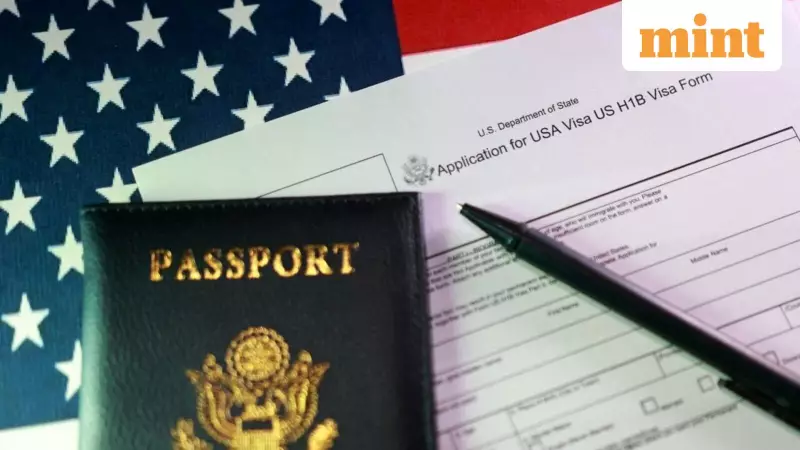
For thousands of Indian professionals building their careers in the United States on an H-1B visa, the prospect of living apart from their immediate family is a significant concern. Fortunately, US immigration regulations provide a clear pathway for reunification. Legally married spouses and unmarried children under the age of 21 are eligible to accompany the primary H-1B holder under the H-4 dependent visa category.
Eligibility and Essential Rules for H-4 Status
It is crucial to understand that the H-4 status is specifically for dependents. This means your spouse or children cannot already possess their own independent immigration status, such as an F-1 student visa, J-1 exchange visa, or even another H-1B. If they do, they must first apply to legally change their status to H-4 to become your dependent.
According to the US Citizenship and Immigration Services (USCIS), maintaining a valid status is the cornerstone of this process. The H-4 dependent's legal standing is intrinsically tied to the primary H-1B holder's status. The primary visa holder must either be physically present in the US or have an approved H-1B petition before the family can join.

Timely filing of extensions is non-negotiable. Whenever the H-1B visa is extended or transferred to a new employer, the H-4 dependents must also file for an extension of their status to remain in compliance.
What H-4 Visa Holders Can and Cannot Do
The H-4 visa offers certain privileges but comes with strict limitations. On the positive side, H-4 holders are permitted to pursue education in the United States, enrolling in part-time or full-time courses at schools, colleges, or universities. They are also allowed to travel internationally and re-enter the country, provided their visa and supporting documents are current and valid.
However, the rules on employment are very clear. Working without authorisation is illegal and can lead to severe consequences, including visa denial and deportation. To work legally, an H-4 spouse must obtain an Employment Authorization Document (EAD) by filing Form I-765, subject to specific eligibility criteria set by USCIS.
Another critical rule involves the duration of stay. An H-4 dependent must not overstay their visa validity, even by a few days, as this can trigger serious immigration problems and jeopardise future visa applications. Their permitted stay is directly linked to the H-1B holder's status validity. Notably, if the H-1B holder obtains extensions beyond the standard six-year limit, the H-4 dependents are also eligible for extensions for the same period.
Navigating Changes and Avoiding Pitfalls
Life circumstances and career moves can impact H-4 status. If the primary H-1B holder changes employers, the dependents will likely need to update their H-4 status accordingly to reflect this change. It is also vital to rely only on official information from USCIS or advice from a qualified immigration attorney, especially during policy shifts, and avoid unofficial guidance.
A significant change occurs when a dependent child turns 21 or gets married. At that point, they no longer qualify as a child under the H-4 regulations. To maintain lawful status in the US, the individual must change to another nonimmigrant status for which they independently qualify, such as an F-1 or H-1B visa.
When applying for the H-4 visa or seeking entry into the US, carrying the proper documentation is essential to prevent delays or rejection. The necessary documents typically include a valid passport, the H-4 visa stamp, the I-94 arrival/departure record, the H-1B holder's approval notice (Form I-797), and proof of relationship like a marriage certificate (for spouse) or birth certificate (for children). Always carry proof of your relationship to the primary visa holder for a seamless process at ports of entry.