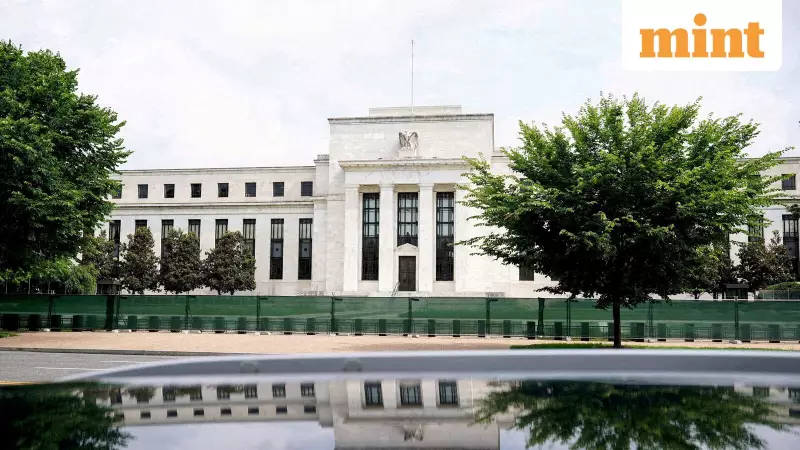
Financial markets are entering the new year with a watchful eye on the Federal Reserve, as investors prepare for a central bank that could look very different from its recent past. While current market volatility remains low, a persistent undercurrent of concern focuses on the potential for a less independent and more politically influenced Fed under President Trump.
A Looming Shift in Leadership and Policy
President Trump has indicated he is close to selecting a new chair for the central bank, with the term of current Chair Jerome Powell set to expire in May 2025. Crucially, Trump has reiterated his demand for significantly lower interest rates, telling The Wall Street Journal he expects the new Fed leader to support his economic agenda. He has suggested rates should be at 1% or lower within a year, a stark contrast to the current benchmark range of 3.5% to 3.75%.
So far, investors have not shown major panic over the Fed completely surrendering its long-held independence. However, many are bracing for a period marked by unusual internal division, a potentially weaker chair, and the ongoing threat of more radical changes to the institution's structure and mandate.

The Mechanisms of Potential Change
The immediate path to greater presidential influence runs through the Federal Open Market Committee (FOMC), the 12-member body that votes on interest rates. While the chair holds considerable sway, they cannot set rates alone. The FOMC consists of seven presidentially appointed Fed governors and five regional Fed bank presidents.
Currently, three governors are Trump appointees. Analysts note that if Trump gets more opportunities to appoint governors in the coming months, he could achieve a majority on the board. One opening could arise if Jerome Powell resigns from the Fed entirely after his chair term ends, following historical precedent. Another could come if the Supreme Court allows the administration to remove Governor Lisa Cook over contested allegations.
"If Trump could replace both Powell and Cook, that gets a lot more interesting," said Blake Gwinn, head of U.S. rates strategy at RBC Capital Markets. A Trump-appointed majority could, in theory, attempt to dismiss regional Fed presidents seen as obstacles to rate cuts, a move that would likely spook financial markets.
Market Risks: Volatility and Higher Yields
Analysts warn that a perceived loss of Fed independence poses a significant threat. A central bank that cuts rates aggressively while the economy is still healthy could trigger investor fears about future inflation, paradoxically driving long-term borrowing costs higher. A sharp rise in Treasury yields could then destabilise stock markets.
Even without a dramatic takeover, a more divided Fed could cause problems. Investors foresee potential scenarios where a new chair pushes for cuts but is outvoted by other officials—a rare event in U.S. central banking history. John Briggs of Natixis notes that if each FOMC member's view carries more weight, it creates uncertainty about the future path of rates, leading to bond market volatility. This uncertainty typically forces investors to demand higher yields as compensation, pushing borrowing costs up.
Some see early signs of concern in the bond market, where the gap between short-term and long-term Treasury yields has recently widened. This can signal that investors expect lower rates soon but are less confident about the long-term outlook, possibly reflecting doubts about Fed stewardship.
The Path to Consensus and the Role of Communication
Not all outlooks are pessimistic. A popular view on Wall Street is that a slowing economy could naturally create consensus at the Fed for further rate cuts, mitigating political divisions. The Fed has already cut its key rate by 1.75 percentage points over the past 15 months.
Many investors believe a new chair could justify moderate cuts based on economic data without appearing purely political. "By the time that person's in the seat... they're going to have a lot more information [and] probably more backing to lower the rate," said Bryan Whalen of TCW.

Communication style will also be critical. Michael Lorizio of Manulife Investment Management argues that a chair who presents a thoughtful economic case for lower rates will be less destabilising than one who merely echoes the President's demands, even if the policy goal is identical. Effective messaging could help maintain stability and the Fed's economic impact.
For now, stock markets have shown limited concern, with sectors like banks and industrials buoyed by the prospect of continued rate cuts. However, as the leadership transition approaches, investors are closely assessing the different paths the Fed could take, knowing that the era of predictable central bank policy may be shifting.