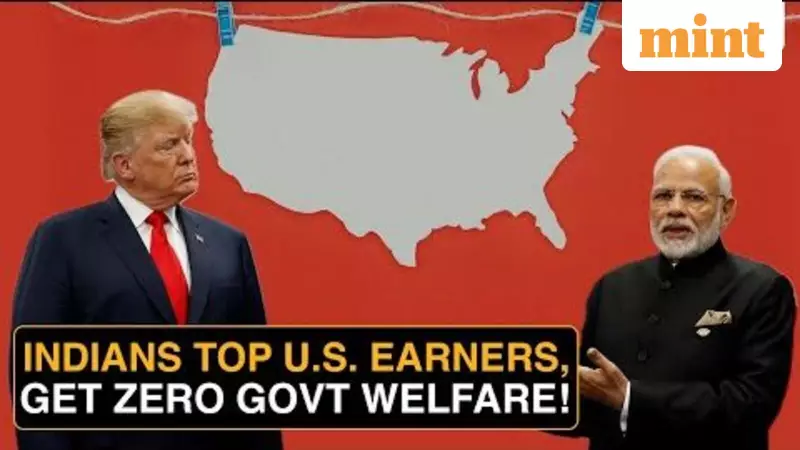
A recent viral chart shared by former US President Donald Trump has sparked significant discussion by exposing welfare dependence rates among immigrant groups from over 120 countries. Notably absent from the list of high-dependency nations was India, strongly implying that immigrants from the South Asian giant have near-zero or negligible reliance on public assistance in the United States.
The Data That Speaks Volumes: India's Notable Absence
The shared data presented a stark contrast in welfare usage. It showed countries like Bhutan with over 80% of immigrant families using welfare, Bangladesh at 55%, Pakistan at 40%, Nepal at 35%, and China at 33%. The complete lack of a figure for India, despite its population being one of the largest sources of skilled immigration to the US, points directly to an exceptionally low rate of public aid utilization. This omission is not an oversight but a powerful indicator of the economic profile of the Indian diaspora.
This data aligns perfectly with established research. According to the Pew Research Center, Indian Americans boast a median household income of $151,000 and a median individual income of $85,000. These figures place the community at the very top of the economic ladder in America, far exceeding the national average. Their financial success inherently translates to a minimal need for state-funded welfare programs.

Skilled Immigration as the Driving Force
The economic story of Indian immigrants is fundamentally tied to the pathways they use to enter the United States. A significant portion arrives through employment-based skilled visa categories, most prominently the H-1B visa program. This program is designed for specialty occupations requiring theoretical or technical expertise, typically in fields like technology, engineering, medicine, and finance.
Unlike some immigration streams, the H-1B route selects for highly educated professionals who are recruited directly into well-paying jobs. These individuals and their families begin their American journey as taxpayers and consumers from day one. They contribute to Social Security, Medicare, and federal and state taxes long before they could ever qualify for or consider most forms of public assistance. This model positions them as immediate net contributors to the US economy and society.
Conclusion: Redefining the Narrative of Contribution
The evidence presents a clear and compelling narrative. The Indian immigrant community in the United States stands out as a paradigm of economic success and self-sufficiency. The combination of high educational attainment, recruitment through skilled visa channels, and resulting high incomes creates a profile diametrically opposed to welfare dependence.
This data challenges broader stereotypes about immigrants and public benefits. It underscores how immigration policy that prioritizes skills and education can lead to immigrant groups that bolster the nation's fiscal health and innovative capacity. The story of Indian immigrants is not one of taking but of making—making significant economic contributions, creating jobs through entrepreneurship, and enriching the cultural and intellectual fabric of America.