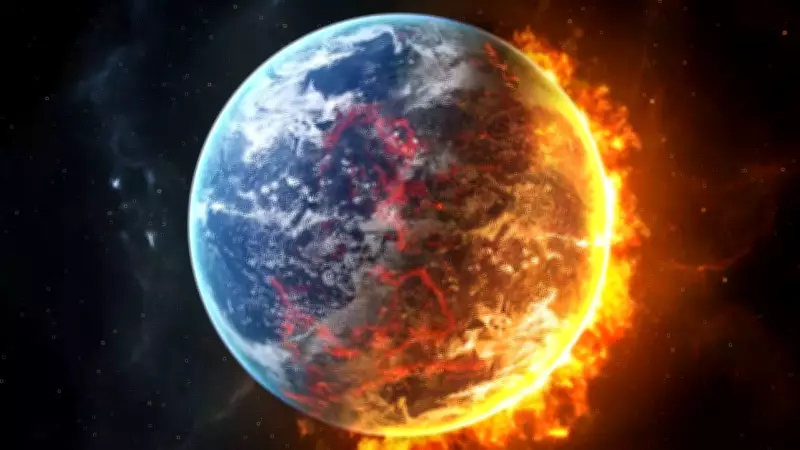
Iron Bar in Ring Nebula: A Cosmic Preview of Earth's Fiery Demise
It sounds like a scene from a science fiction blockbuster, but astronomers confirm this chilling scenario could one day be Earth's reality—though not for another five billion years. In a groundbreaking study, scientists have detected a bizarre strip of iron stretching across the Ring Nebula, resembling a cosmic bar floating eerily in space. This discovery might just offer a sneak peek at our own planet's ultimate fate.
A Stellar Mystery Unraveled
Published in Oxford Academic under the title 'WEAVE imaging spectroscopy of NGC 6720: an iron bar in the Ring', the research delves into the Ring Nebula, located just over 2,200 light-years away. Known for its stunning glowing ring of gas and dust, this nebula is often hailed as a stellar masterpiece. Using an advanced tool called the Large Integral Field Unit (LIFU), researchers scanned the nebula across hundreds of wavelengths of light, revealing an unexpected iron bar positioned at the center of the ring.
Experts are divided on its origins. Some hypothesize it formed as the outer layers of a dying star expanded, while others suggest it could be the vaporized remains of a planet that ventured too close to its host star. If the latter proves true, this iron bar serves as a haunting preview of what might await Earth in the distant future.

How the Sun Could End Life on Earth
Stars like our sun spend billions of years fusing hydrogen into helium. When this fuel depletes, the core contracts, and the outer layers swell, transforming the star into a massive red giant. For Earth, this spells catastrophe. According to reports from Space.com, the sun could expand to 100 to 200 times its current size, potentially roasting, shredding, or engulfing our planet within its outer layers.
Not all planets face such a grim fate. Those orbiting farther out might survive, drifting around the white dwarf remnant left behind. However, for Earth, the outlook is bleak. The iron bar in the Ring Nebula could be tangible evidence of what happens when a rocky planet like ours gets too close to a dying star.
Insights from the Discovery
This finding sheds light on the life cycles of stars and the survival limits within solar systems. As cited in ScienceDaily reports, Dr. Roger Wesson, one of the researchers, notes that the bar's iron content could match that of Earth or Venus, providing a crucial clue. However, he cautions that it might not originate from a planet at all, emphasizing the need for further investigation. Scientists aim to identify similar bars in other nebulae, each potentially adding a piece to this cosmic puzzle.
Envisioning Earth's Distant Future
It's an eerie thought: a glowing nebula light-years away possibly displaying the remnants of a planet akin to ours. While the sun has billions of years remaining, making immediate panic unnecessary, the eventual destruction of Earth seems inevitable. One day, future astronomers might spot our planet's ashes stretched across space as another iron bar in the vast cosmic sea.
If the Ring Nebula is any indication, Earth's grand finale could be a spectacular, fiery spectacle, marking the end of an era in our solar system's history.