

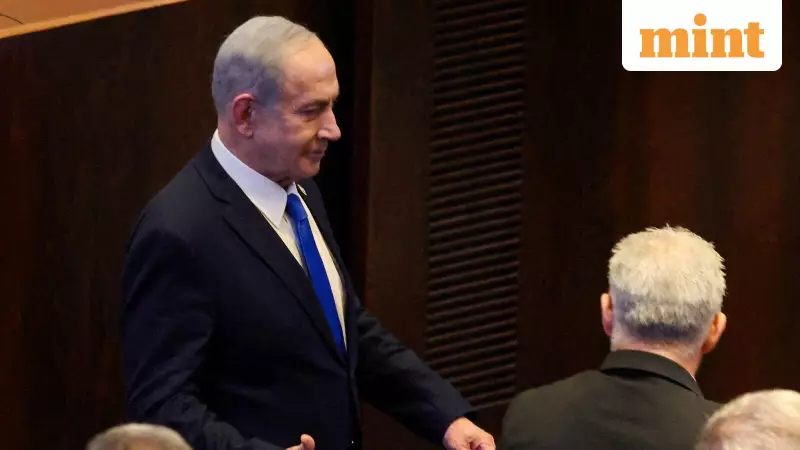
Israel's Political Crossroads: The Netanyahu Question
The political future of Israel stands at a critical juncture as questions mount about whether the nation can move beyond the long-standing leadership of Prime Minister Benjamin Netanyahu. With evolving dynamics in US-Israel relations and internal domestic challenges, the Jewish state faces complex decisions that could reshape its political landscape.
Evolving US-Israel Relations Under Trump Administration
As former President Donald Trump contemplated potential military actions against Iran, the strategic partnership between the United States and Israel underwent significant transformation. The Trump administration collaborated with Israel to execute strikes on Iran's nuclear facilities during the previous summer, achieving an objective that Netanyahu had persistently pursued for years.
However, Netanyahu discovered what other allies have learned before him: Trump's approach to international relationships remains fundamentally pragmatic rather than sentimental. After pressuring Israel to conclude the Gaza conflict earlier than Netanyahu preferred, Trump proceeded to invite Turkey and Qatar to participate in the newly established US-sponsored Board of Peace, despite Israel's objections. This board was tasked with overseeing Gaza's reconstruction and governance.

Netanyahu, who had strategically shifted Israel's traditional bipartisan American support toward alignment with the Republican Party, found himself compelled to accept these developments. This situation highlights the changing dynamics in international diplomacy affecting Israel's strategic positioning.
Strategic Analysis: The Iranian Threat Framework
In a revealing interview conducted on January 24th with Yossi Klein Halevi, a senior fellow at Jerusalem's Shalom Hartman Institute and respected analyst of Israeli society, a comprehensive framework emerged regarding Israel's approach to the Iranian threat. Halevi described the Gaza war as profoundly traumatic for Israeli Jews, with psychological impacts likely to persist for an extended period.
According to Halevi's analysis, Israel's strategy against Iran unfolds across three distinct phases:
- Phase One: Targeting Iran's proxy terrorist networks to dismantle the Tehran-backed encirclement of Israel through Gaza, Lebanon, and Syria.
- Phase Two: Executing strikes against Iran's nuclear program during the previous summer to weaken the core of the existential threat.
- Phase Three: Ultimately removing Iran's clerical regime, which has increasingly lost popular support and maintains power primarily through coercive force.
When questioned about how this final phase might succeed where recent massive anti-government demonstrations in Iran failed, Halevi provided a concise response: If the United States and Israel can deliver a substantial blow to the Islamic Revolutionary Guard Corps—the primary instrument maintaining the regime's control—Iran's professional military might refuse to suppress subsequent protest waves, potentially leading to the regime's collapse.
Domestic Political Landscape and Netanyahu's Vulnerabilities
The Gaza conflict has generated significant domestic political consequences alongside its geopolitical implications. Public opinion surveys indicate that Netanyahu's attempts to avoid responsibility for the national security failures that enabled the October 7th, 2023 massacre have solidified his base support but failed to convince the broader electorate that will determine the next parliamentary majority.
Most Israeli citizens currently express distrust toward their prime minister. If elections were conducted immediately, Netanyahu's coalition would likely face defeat. However, with several months remaining before potential elections, the prime minister could employ aggressive campaign tactics to secure victory—a strategy with historical precedent in Israeli politics.

Pro-Netanyahu factions have already circulated allegations that Israel Defense Forces and intelligence officials deliberately withheld information about the impending Hamas attack to undermine the prime minister's credibility. Additionally, they claim that an opposition victory would enable an Arab party allegedly linked to the Muslim Brotherhood to join the governing coalition.
The Rising Opposition: Naftali Bennett's Challenge
Yossi Klein Halevi expresses skepticism about Netanyahu's ability to achieve another electoral victory. The prime minister has reportedly lost credibility among the "soft right" segment of the political spectrum, whose support remains essential for any governing coalition.
Netanyahu's primary opponent, Naftali Bennett, who previously served as prime minister from 2021 to 2022, is conducting an effective campaign to replace the current leadership. Bennett contrasts his record as a unifying figure against Netanyahu's history of exacerbating Israel's societal divisions. Furthermore, Bennett has accused the prime minister's office of treason regarding allegations that Netanyahu's aides accepted payments from the Qatari government.
Bennett's platform includes commitments to redirect substantial subsidies currently allocated to Israel's ultra-Orthodox communities toward bolstering the nation's underfunded reserve forces—a proposal with significant political implications.
Coalition Fragility and Societal Divisions
Netanyahu's political vulnerabilities extend beyond electoral challenges. The contentious issue of ultra-Orthodox military service exemptions continues to fracture his governing coalition. Ultra-Orthodox political leaders have warned that unless the government maintains their community's exemption from military conscription, they will vote against Netanyahu's proposed budget, potentially collapsing the government and triggering new elections.
Simultaneously, religious Zionists within the coalition—whose young supporters undertook the most dangerous assignments in Gaza and suffered disproportionate casualties—strongly oppose codifying draft exemptions for the ultra-Orthodox population. While this issue has long generated controversy, the Gaza conflict has intensified emotions surrounding the debate.
Increasing numbers of Israelis now perceive the ultra-Orthodox community as failing to contribute adequately to national economic and security needs, creating growing public unwillingness to accept the status quo.
Conclusion: Israel's Political Transition
Yossi Klein Halevi concludes that Netanyahu has exhausted his capacity for dramatic political escapes and will likely be compelled to leave office in the foreseeable future. This potential transition carries significant implications for how Americans, including American Jewish communities, perceive Israel's political evolution.
Netanyahu's re-election could potentially convince many Americans that the Israel they have traditionally cherished has transformed into a political entity with a majority they neither comprehend nor support. As Israel navigates complex international relationships and internal divisions, the question of moving beyond the Netanyahu era represents more than mere political change—it signifies a potential redefinition of Israel's national identity and international relationships.





