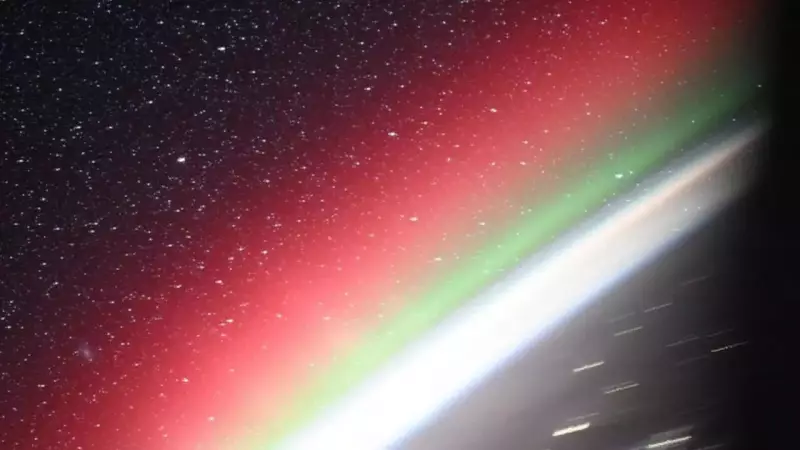
A single, breathtaking photograph taken from the International Space Station (ISS) has created a powerful visual bridge between our daily existence on Earth and the immense cosmos beyond. Shared by NASA astronaut Don Pettit on X, the image masterfully frames our planet's glowing horizon, dotted with winter city lights, against the distant backdrop of the Andromeda Galaxy.
The Cosmic Tapestry: Aurora, Cities, and a Neighbouring Galaxy
This remarkable orbital photograph is more than just a beautiful picture; it is a confluence of multiple scientific narratives. It arrives at a time when observations from space are increasingly vital for understanding Earth's systems and for engaging the public with astronomy. The image uniquely combines atmospheric phenomena, human activity, and deep-space objects, offering a holistic and scientifically rich perspective of our planet as part of a vast universe.
Decoding the Glowing Horizon: Auroras and Airglow
The softly glowing band tracing Earth's curve in the photo is a result of aurora and airglow. These luminous displays are born from the interaction of solar particles with our planet's upper atmosphere. Energetic electrons and protons from the Sun travel along magnetic field lines and collide with oxygen and nitrogen atoms, exciting them to emit light. From the vantage point of the ISS, these emissions appear as dynamic, layered curtains wrapping around the night side of Earth.

A study highlighted in Scientific Reports explains how variations in solar activity influence the intensity and distribution of this auroral light. The image perfectly illustrates why low Earth orbit provides an exceptional platform for monitoring these space weather events on a global scale, showing the aurora as a thin, vibrant boundary between our world and the void of space.
Human Footprint in Lights: What Cities Reveal from Orbit
Beneath the atmospheric glow, the photograph reveals scattered clusters and networks of lights outlining cities and towns during the winter season. For years, night-time satellite imagery has been an indispensable tool for researchers studying human settlement patterns, economic growth, and energy consumption. Artificial lighting acts as a measurable signal, allowing comparisons between regions and over time to track urban expansion and infrastructure development.
From orbit, these city lights starkly reveal the contrast between densely populated zones and dark, sparsely inhabited landscapes, making developmental inequalities visibly apparent. Pettit's capture shows how human-generated light has transformed Earth's night environment into a luminous footprint. This perspective is crucial for environmental studies, particularly those examining light pollution and its impacts on nocturnal wildlife and human health.
Andromeda's Distant Glow: A Galactic Perspective from Near Earth
Perhaps the most awe-inspiring element is the faint, elongated smudge of light visible beyond Earth's bright limb: the Andromeda Galaxy (M31). As the closest major spiral galaxy to our Milky Way, located about 2.5 million light-years away, Andromeda is one of the most studied celestial objects. Its inclusion in a photograph taken from near-Earth orbit is exceptionally rare, as capturing such a distant object requires careful framing and minimal atmospheric interference.
Placing Andromeda in the same frame as Earth dramatically highlights the scale difference between planetary and galactic structures. Astronomers extensively study Andromeda to understand star formation, dark matter, and the future of our own galaxy, as the Milky Way and Andromeda are destined to merge billions of years from now. Its presence in this photo is a profound visual reminder that our home planet resides within a much larger cosmic neighbourhood.
Why the ISS is the Perfect Platform for Such Rare Images
The International Space Station, orbiting roughly 400 kilometres above Earth, serves a dual role as a research lab and an unparalleled observation post. Its altitude and human presence provide a flexibility that automated satellites often lack. Astronauts can use their judgment to seize fleeting moments when atmospheric conditions, lighting, and celestial alignments converge perfectly.

Advancements in digital camera sensitivity have further enhanced this capability, allowing the capture of faint astronomical objects and subtle atmospheric details. While such images are widely shared for their aesthetic appeal, they also contribute to scientific knowledge by documenting transient events and providing contextual views that aid research in Earth science and astronomy. Pettit's photo is a prime example of how orbital imagery serves both analytical and educational purposes.
How Space Images Shape Public Understanding of Science
Images that juxtapose familiar earthly scenes with cosmic vistas play a crucial role in shaping public perception of science. This photograph connects Earth's inhabited surface and its atmospheric processes with a neighbouring galaxy, creating a tangible link between human experience and the cosmic scale. Shared rapidly on social media platforms like X, such visuals spark widespread curiosity and discussion about space science, climate, and astronomy.
This form of communication does not replace detailed data analysis but powerfully complements it by providing an intuitive vision of complex systems. The image shared by Don Pettit exemplifies how thoughtful orbital photography can foster informed public engagement, linking precise scientific observation to a broader understanding of Earth's place in the universe.