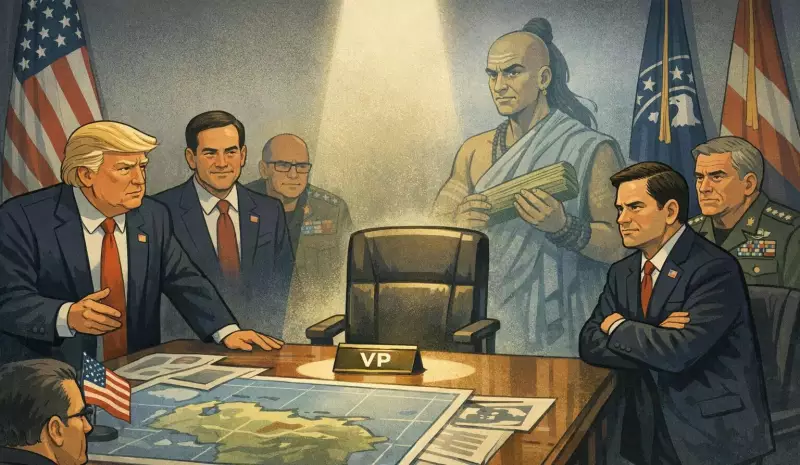
When former President Donald Trump gathered his inner circle at Mar-a-Lago to celebrate a daring military operation in Venezuela, a key figure was missing from the victory tableau. As Secretary of State Marco Rubio beamed and other officials crowded around tactical maps, the chair of Vice President J.D. Vance remained conspicuously empty.
A Conspicuous Absence and a Strategic Silence
The event last weekend, which had the theatrics of an action movie, marked the successful capture of Venezuelan leader Nicolás Maduro. Yet, Vice President Vance was absent not only from the impromptu "war room" where the raid on Caracas was green-lit but also from the subsequent press conference where the administration hailed its "perfect" operation.
In Washington, absences speak volumes. While some are logistical, others are deeply political. Vance's no-show felt distinctly like the latter, immediately triggering whispers across the capital. Equally notable was the muted response from another unlikely Trump appointee, Director of National Intelligence Tulsi Gabbard, who offered a single, stiff social media post congratulating the forces.

The operation, dubbed "Absolute Resolve," was presented as a precision strike. Public messaging, however, was fragmented. Trump spoke of controlling Venezuelan oil, Rubio framed it as an anti-Communist crusade, while others emphasized narco-trafficking and hemispheric security. In a coherent administration, the Vice President often acts as the unifying translator for such mixed messages. Vance's absence left that crucial role unfilled.
Vance's Calculated Response and the Chanakya Parallel
After days of silence, Vance finally addressed the operation with a lengthy post on X. His tone was cautious, lawyerly, and starkly different from the chest-thumping bravado of Trump and Rubio. He ticked through justifications like narcotics and cartels but addressed the oil motive with the care of "stepping over broken glass."
He pointed to past expropriation of American oil assets, calling them "stolen property" used, "until recently," to fund criminal activity. That careful phrase—"until recently"—acted like a legal footnote, leaving room for interpretation. He concluded with a plaintive rhetorical question, far from a rallying cry. This was not a leader building public support, but one explaining a contradiction.
This behaviour echoes the ancient Indian strategic doctrine of Chanakyaneeti, attributed to the philosopher Chanakya. The principle advocates for strategic restraint, keeping one's options open, and avoiding having your name attached to a potentially failing venture. Given Vance's personal connections to India and his fondness for civilisational discourse, this template of calculated distance seems apt. He let Rubio take the public victory lap, staying offstage to avoid direct ownership of a risky geopolitical move.
The Succession Calculus and the Evolution of Hillbilly Hope
Vance's absence is more than a curiosity; it's a succession story. Widely seen as the crown prince to Trump's political movement, Vance must balance loyalty with his own political future. The Venezuela operation is politically risky, appealing to hawkish factions but alienating the non-interventionist streak within Trump's own base.
By distancing himself, Vance engages in a classic hedging strategy. If the operation becomes popular, he can endorse it later. If it sours, he can point to his early distance. This allows him to remain viable to all parts of the MAGA coalition. Meanwhile, Rubio, a rival for future influence, embraced the hawkish moment, cementing his role as the "man of action" to Vance's "man of continuation."
This is the evolution of the "Hillbilly Hope" that once defined Vance. The man who narrated American decline in Hillbilly Elegy has become a methodical student of power. His actions show an understanding that in Trump's world, dissent is remembered as betrayal, and sometimes, survival means letting others take the applause—and the blame. His absence was not a sign of weakness, but a demonstration of a brutal political intelligence focused on one goal: outlasting the moment to be the one still standing when the music stops.