

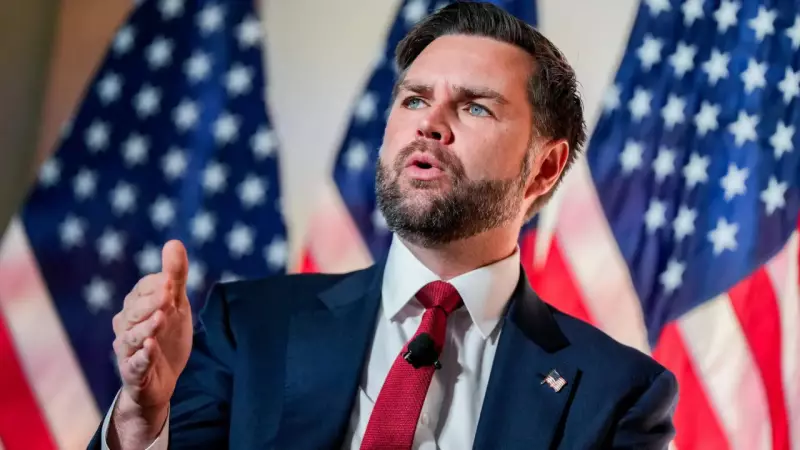
Vice President of the United States, JD Vance, has ignited a significant political controversy by publishing a series of four social media posts defending the actions of an Immigration and Customs Enforcement (ICE) officer who shot and killed a Minneapolis mother, Renee Good, on Wednesday. The posts, interpreted as official statements from his position, have drawn sharp condemnation from political opponents and advocacy groups, including the Indian-American Advocacy Council.
Four-Post Defense: From 'Tragedy of Her Own Making' to 'Gaslighting'
Instead of releasing a formal, measured statement, Vance took to social media to present his views on the incident. His first statement labelled the death a "tragedy of her own making." Reacting to video footage, Vance asserted, "Don't illegally interfere in federal law enforcement operations and try to run over our officers with your car. It's really that simple."
In his second post, Vance amplified his support, directly addressing ICE officers: "I want every ICE officer to know that their president, vice president, and the entire administration stands behind them." He added a warning to critics, saying, "To the radicals assaulting them, doxxing them, and threatening them: congratulations, we're going to work even harder to enforce the law."

The third statement took a more explicitly political tone, referring to the deceased, Renee Good, as a "deranged leftist." Vance challenged Democrats, demanding they answer whether they believed the officer was wrong for defending his life. "These people are going to try to arrest our law enforcement for doing their jobs. The least the media could do is ask them about it," he wrote.
His fourth and longest post accused critics of widespread "gaslighting." Vance outlined points blaming Good and exonerating the officer, concluding, "A tragedy? Absolutely. But a tragedy that falls on this woman and all of the radicals who teach people that immigration is the one type of law that rioters are allowed to interfere with."
Widespread Condemnation and a Sharp Rebuke from the Indian-American Community
The response to Vance's posts was swift and critical. Many social media users expressed alarm, suggesting that as president, Vance could be "much worse" than former President Donald Trump, arguing that Trump did not continuously defend such incidents. Critics questioned why the Vice President chose a social media campaign over an official, dignified statement.
The condemnation extended beyond domestic political circles. The Indian-American Advocacy Council issued a strong statement, declaring that "cowards should not become the president of the US." The council's co-founder clarified that their issue was not with the ongoing investigation into the agent's actions but with Vance's response.
"I don’t care whether the ICE agent is ultimately found at fault or not; that’s for investigators to determine. What is unacceptable is the tone-deaf, divisive response from JD Vance," the statement read. "Instead of calling for facts, restraint, and unity, he’s doubling down, posturing, and trying to turn a serious situation into a political ruckus."
A Deepening Political Divide
This incident highlights the intensely polarized climate surrounding immigration enforcement and political rhetoric in the United States. Vance's decision to communicate via multiple, confrontational social media posts represents a modern, direct-to-public approach that bypasses traditional channels. However, it has been criticized for inflaming tensions during a sensitive investigation into a loss of life.
The forceful intervention by the Indian-American Advocacy Council underscores how domestic US events resonate with and mobilize the diverse diaspora communities, who are increasingly vocal on issues of governance, civil rights, and political discourse. The fallout from the Minneapolis shooting and the Vice President's reaction continues to unfold, setting the stage for further political debate.






