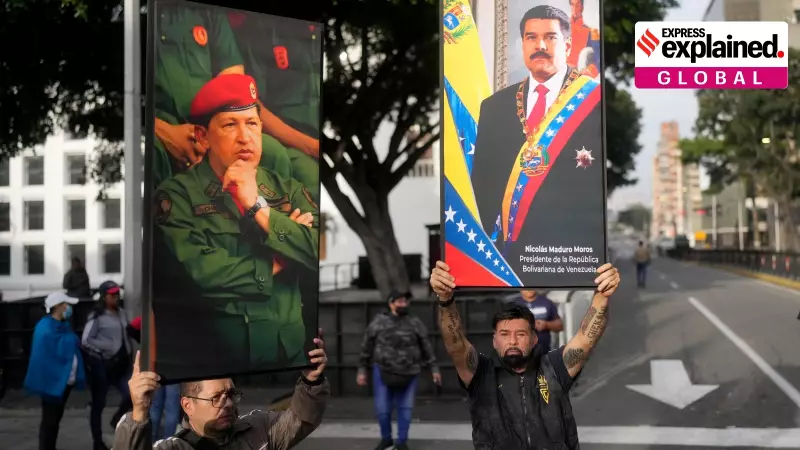
In a stunning geopolitical development, the United States has announced the capture of Venezuelan President Nicolas Maduro, bringing an extraordinary end to his nearly 13-year rule. The announcement, made by US President Donald Trump on Saturday, January 3, 2026, stated that Maduro and his wife were apprehended and flown out of Venezuela following large-scale American military strikes on the country.
The Rise of a Political Heir
Nicolas Maduro's journey to the pinnacle of power in Venezuela is a tale of dramatic political ascent. Born in 1962 into a leftist family as the son of a union leader, Maduro initially worked as a bus driver in the capital, Caracas. He followed his father's path, becoming a trade union negotiator, which served as his entry point into politics.
His political fortunes changed when he became involved with Hugo Chavez's United Socialist Party. Rising swiftly through the party's trade union ranks, he was first elected to Venezuela's National Assembly in the year 2000. His trajectory was meteoric: he became head of the National Assembly in 2005, served as Foreign Minister from 2006, and was appointed Vice President under Chavez from 2012 to 2013. Chavez personally anointed Maduro as his successor in 2011.

Following Chavez's death from cancer in 2013, Maduro narrowly won a special presidential election, assuming the leadership of a nation rich in oil but already showing signs of deep structural economic problems.
An Iron-Fisted Rule Amid Economic Collapse
Maduro inherited a government and an economy heavily dependent on oil exports, with little diversification. The crash in global oil prices in 2014 plunged Venezuela into a profound crisis, triggering hyperinflation and severe shortages of food, medicine, and other essential goods.
His grip on power, however, remained firm. Despite opposition parties gaining control of the National Assembly in 2015, Maduro retained control through strategic alliances with the Supreme Tribunal, the National Electoral Council, and the crucial support of the military.
The human cost of the economic collapse was catastrophic. Between 2013 and 2016, food imports fell by 71% and medicines by 68%, while infant mortality surged by 44%. Inflation, a key indicator of the crisis, exploded from 255% in 2016 to an almost unimaginable one million percent by September 2019. The average inflation rate for Venezuela is estimated to be around 225% in 2026.
Maduro consistently blamed US sanctions for the nation's suffering. A 2024 Human Rights Watch report painted a grim picture, stating that over 20 million Venezuelans out of a population of 28.8 million lived in multidimensional poverty, with 14.2 million facing severe humanitarian needs. Roughly eight million citizens have fled the country since 2014.
International Isolation and the Final Showdown
Maduro's rule was characterized by escalating tensions with the United States. While the two nations historically had close relations due to Venezuela's role as a major oil supplier, friction that began under Chavez intensified dramatically under Maduro. The US viewed his government's crackdowns on opposition, media, and civil society as a severe deterioration of democracy and human rights.
In response, Washington employed a strategy of maximum pressure, recognizing opposition figure Juan Guaidó as the legitimate president in January 2019 and imposing sweeping financial and individual sanctions. The pressure campaign ramped up significantly in the final months, with the Trump administration conducting strikes on Venezuelan vessels allegedly involved in drug trafficking and building up military presence in the Caribbean Sea.
Maduro's controversial re-election in 2018 and again in 2024—elections widely condemned by international observers and marred by allegations of fraud—further cemented his image as an authoritarian leader clinging to power. The final act came just days after Maduro expressed openness to talks with the US on drug trafficking and oil, a gesture that did little to halt the escalating confrontation.
The capture of Nicolas Maduro marks a pivotal moment for Venezuela, closing a chapter defined by economic devastation, a massive humanitarian exodus, and allegations of authoritarianism. The world now watches to see what comes next for the oil-rich nation and its people.