

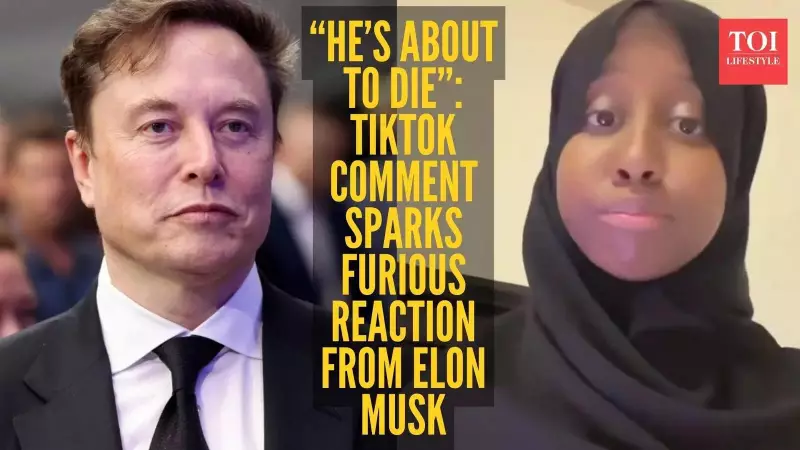
Elon Musk, the billionaire tech mogul, has issued a stark declaration of "war" following a disturbing remark made about him during a TikTok livestream. The incident, which began with a Somali content creator's comment, has rapidly escalated into a major controversy involving online threats, political calls for deportation, and a heated national discussion on large-scale fraud and immigration.
The Livestream That Sparked the Firestorm
The controversy originated from a live video hosted by a creator known online as Dowza.z, whose account has since been removed from the platform. During the stream, which was a reaction to Musk's recent statements on alleged fraud involving Somali-run businesses in Minnesota, the creator switched between Somali and English. At a pivotal moment, she directly referenced Elon Musk, stating in English, "I wouldn't worry too much about him, he about to die."
The clip quickly went viral across social media platforms, with numerous users interpreting the statement as a direct threat against Musk's life. The backlash was swift and severe, drawing the attention of the SpaceX and Tesla CEO himself.

Musk's Blunt Retort and Political Backlash
Elon Musk did not hesitate to respond. Taking to his social media platform X (formerly Twitter), he posted a concise but loaded four-word reply: "Then it is war." This response dramatically intensified the already volatile situation.
Political figures were quick to weigh in. Republican Senator Mike Lee from Utah reacted sharply to the incident, publicly calling for the immediate deportation of the TikTok creator. However, details about the creator's location, citizenship, or immigration status remain unclear.
The issue was further amplified by influential accounts on X. DogeDesigner, with a following exceeding 1.7 million, posted a message urging to "Protect Elon Musk at all costs." Similarly, Libs of TikTok, which boasts roughly 4.5 million followers, asserted that the creator had "appeared to threaten" Musk's life during an emotional livestream.
The Broader Context: Minnesota Fraud Scandals and National Repercussions
This explosive online exchange did not occur in a vacuum. It comes at a time when the state of Minnesota is under intense scrutiny for massive fraud cases allegedly involving members of the Somali American community. The most prominent among these is the "Feeding Our Future" case, where federal prosecutors have charged at least 77 individuals in a scheme accused of exploiting pandemic-era child nutrition programs to the tune of $250 million.
Another parallel investigation is examining the suspected misuse of funds within Minnesota's Housing Stability Services Program, which is linked to Medicaid.
The political fallout from these fraud cases has been significant. Former US President Donald Trump has announced plans to end Temporary Protected Status for Somali migrants residing in Minnesota. This move coincides with renewed enforcement efforts by the Department of Homeland Security targeting individuals accused of fraud.
Elon Musk has been vocal on this broader issue. In recent posts, he claimed the Minnesota case is merely a single example of a widespread national problem. Musk stated that while leading the Department of Government Efficiency under the Trump administration, his team uncovered "hundreds" of similar fraud schemes across the United States. "There was massive fraud in every government program," Musk wrote, highlighting that federal funds distributed to states as block grants were particularly vulnerable to exploitation.
What started as a fleeting comment on a social media livestream has now transformed into a national flashpoint. It intertwines concerns over online threats, political rhetoric, immigration policy, and the integrity of government welfare programs, showcasing how a single online incident can ignite a complex, multi-layered debate.






