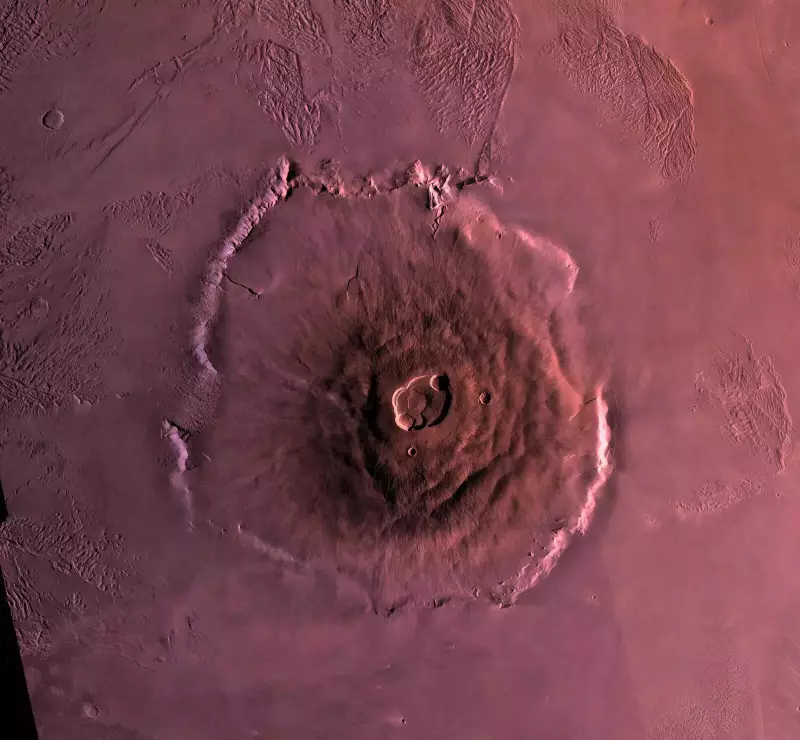
At first glance, the mighty Olympus Mons on Mars might not strike you as particularly impressive. It appears as a broad, pale swell against the planet's iconic rust-colored plains, lacking a sharp, dramatic peak. Its true, mind-bending scale only becomes apparent when you add the numbers. This single volcanic structure towers higher than any mountain on Earth and sprawls wider than many nations, yet it doesn't dominate the Martian landscape in an expected way. For years, NASA researchers have been deciphering the story this geological behemoth tells. Their findings, gathered from its summit and vast slopes, have upended old theories about how planets evolve when their crust remains static, unlike Earth's constantly shifting tectonic plates.
The Colossal Scale of a Martian Giant
Located in Mars's western hemisphere near the equator, Olympus Mons sits atop the Tharsis region, a massive volcanic plateau. NASA measurements reveal its staggering dimensions: it soars roughly 26 kilometres above the surrounding plains. Its base stretches over an astonishing 600 kilometres across. To put that in perspective, a person standing at its edge would be unable to see the summit due to the planet's curvature and the volcano's gentle slope. The mountain is encircled by a vast, cliff-like scarp several kilometres high, with a complex, overlapping caldera at its center. It is less a peak and more an immense, gradual rise that seems to go on forever.
A Surprising Discovery: Frost on a Volcanic Summit
In a 2024 revelation, researchers made a startling detection: frost near the summit of Olympus Mons. While the volume of water involved is modest by terrestrial standards—estimated to be equivalent to about 60 Olympic-sized swimming pools—its presence is profoundly surprising. This frost appears and vanishes with the Martian seasons, clinging to terrain that was forged by immense volcanic heat. This finding is not direct evidence of life or current activity, but it adds a crucial, subtle detail to the complex portrait of a volcano that defies simple explanation.

How Did Olympus Mons Get So Big?
The secret to its size lies in its nature as a shield volcano and Mars's lack of plate tectonics. On Earth, volcanoes like those in Hawaii form from runny lava that spreads out, creating broad, low-profile mountains. However, Earth's moving crust eventually carries the volcano away from its magma source, limiting growth. Mars operates differently. Its crust is mostly fixed. Olympus Mons remained stationed over a persistent hot spot in the Tharsis region. Lava erupted repeatedly in the same location for millions of years, with nothing to move the crust or stop the process. The result is a mountain built layer upon layer to a scale that feels disproportionate to the planet itself.
Its flat appearance is a direct result of this formation process. The easily flowing lava created extremely gentle slopes that extend for hundreds of kilometres, making the volcano look almost serene from orbit. Interestingly, long before space probes arrived, Earth-based astronomers noted a bright patch they named Nix Olympica (Olympic Snow). It wasn't until NASA's Mariner 9 mission in 1971 that this feature was confirmed to be a gigantic volcano, not surface ice, rewriting planetary science record books.
Is Olympus Mons truly dead? While not erupting today, it may be geologically younger than it appears. Some lava flows are estimated to be only about 25 million years old, which is recent in the lifespan of a planet. Evidence suggests a long, intermittent history of activity rather than one continuous eruption. Mars's thin atmosphere and absence of flowing water have also played a key role, preserving the volcano's pristine, monumental shape with very little erosion.