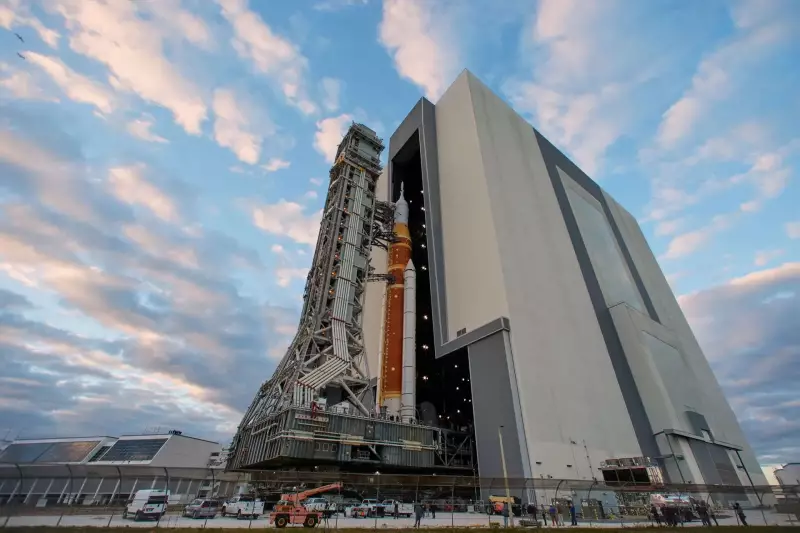
NASA's Giant Moon Rocket Begins Historic Journey to Launch Pad
NASA's enormous new moon rocket started moving toward the launch pad early Saturday morning. This crucial step prepares for astronauts' first trip around the moon in more than half a century. The highly anticipated mission could blast off as early as February.
Slow and Steady Rollout
The massive 322-foot rocket began its careful journey from Kennedy Space Center's Vehicle Assembly Building at daybreak. Moving at just one mile per hour, the four-mile trip to the launch pad was expected to take until nightfall. Thousands of space center workers and their families gathered in the predawn chill to witness this long-awaited event.
People huddled together as the Space Launch System rocket emerged from the historic building. This same facility was constructed in the 1960s to handle Saturn V rockets that carried 24 astronauts to the moon during the Apollo program.

Heavyweight Champion
Weighing an incredible 11 million pounds, the Space Launch System rocket and its Orion crew capsule traveled aboard a massive transporter. This same vehicle was used during both the Apollo and space shuttle programs. Engineers had to upgrade it to handle the SLS rocket's extra weight.
NASA's new administrator Jared Isaacman led the cheering crowd alongside all four astronauts assigned to this mission. The excitement was palpable as the rocket began its slow journey toward the launch site.
Learning from Experience
This marks only the second time NASA has launched the Space Launch System rocket. The first test flight occurred back in November 2022, sending an empty Orion capsule into orbit around the moon.
"This one feels a lot different," said NASA's John Honeycutt on the eve of the rollout. "We're putting crew on the rocket and taking them around the moon."
The initial test flight revealed some issues that needed fixing. Heat shield damage and other capsule problems required extensive analysis and testing. These repairs pushed back this first crewed moonshot until now.
The Mission Ahead
Commander Reid Wiseman will lead the 10-day mission alongside pilot Victor Glover and mission specialist Christina Koch. All three are experienced NASA astronauts with previous spaceflight experience. They will be joined by Canadian astronaut Jeremy Hansen, a former fighter pilot making his first trip to space.
These four astronauts will become the first people to travel to the moon since Apollo 17's Gene Cernan and Harrison Schmitt completed their mission in 1972. During the Apollo program, twelve astronauts actually walked on the lunar surface, beginning with Neil Armstrong and Buzz Aldrin in 1969.
For this Artemis mission, the crew won't orbit the moon or land on its surface. That historic step will come during the third Artemis flight planned for a few years from now.
Next Steps Toward Launch
NASA plans to conduct a crucial fueling test of the SLS rocket on the pad in early February. The results of this demonstration will help determine the exact launch date.
"That will ultimately lay out our path toward launch," explained launch director Charlie Blackwell-Thompson on Friday.
The space agency faces a tight schedule with only five possible launch days in the first half of February. If they miss this window, the mission would need to wait until March for another attempt.
This rollout marks a significant milestone in NASA's Artemis program, which aims to return humans to the moon and eventually establish a sustainable presence there. The entire space community watches with anticipation as this giant rocket prepares for its historic journey.