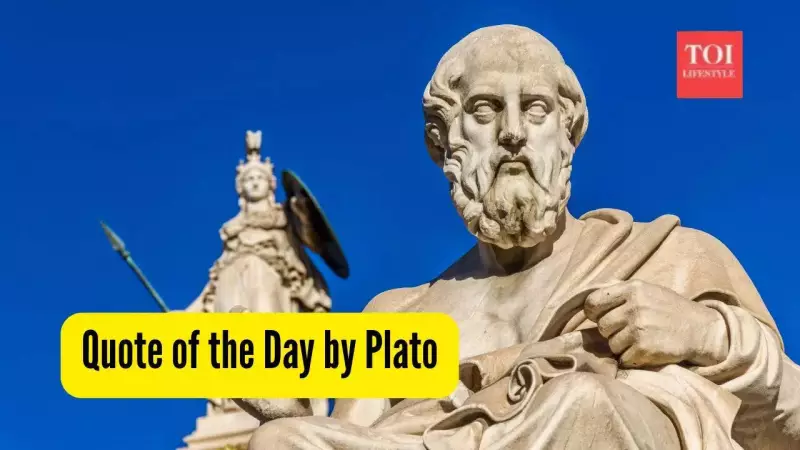
In the heart of ancient Athens, a thinker emerged whose ideas would echo through millennia, shaping the very bedrock of Western civilization. Plato, born around 428 BC into an aristocratic family, began his journey not in a library, but as a wrestler and poet. His life took a definitive turn when he became a devoted student of the provocative philosopher, Socrates.
From Student to Founder: The Journey of a Philosopher
The execution of his mentor, Socrates, on charges of corrupting the youth, was a profound shock. This event propelled Plato to travel extensively, journeying to Egypt and Italy where he studied mathematics with followers of Pythagoras. He absorbed diverse knowledge before returning to Athens around 387 BC to establish the Academy. This institution is widely recognized as the world's first university, a centre of learning that operated for nearly 900 years and produced giants in mathematics, astronomy, and political theory.
Plato's philosophical legacy is primarily contained in his written works, approximately 30 dialogues that often feature Socrates in conversations exploring profound concepts like justice, love, and truth. Through these writings, he introduced groundbreaking theories that continue to be debated.

Core Philosophies: The World of Forms and Ideal Rule
One of Plato's most significant contributions is the Theory of Forms. He proposed that the tangible world we perceive through our senses is merely an imperfect shadow of a higher, perfect reality. True reality, according to Plato, consists of eternal and unchangeable "Forms" or "Ideas," such as the perfect essence of Beauty, Justice, or a Circle. He championed the supremacy of reason and mathematical truth over sensory experience.
In his seminal work, The Republic, Plato envisioned an ideal society governed not by politicians, but by philosopher-kings—wise rulers trained in philosophy and ethics. He believed that only those who comprehend the Form of the Good are fit to lead, ensuring a just and harmonious state.
A Revolutionary Approach to Education and Parenting
Beyond metaphysics and politics, Plato offered remarkably modern insights into education. His famous quote encapsulates this vision: “Do not train a child to learn by force or harshness; but direct them to it by what amuses their minds, so that you may be better able to discover with accuracy the peculiar bent of the genius of each.”
In plain terms, Plato warned against forcing knowledge upon a child through fear or punishment, arguing that such methods crush natural curiosity and create resentment. Instead, he advocated for guidance through engagement. The key is to use play, stories, and games—things that amuse and spark joy—to make learning an attractive adventure. This approach allows a child's innate talents and unique "spark" to surface naturally.
He understood that children are not identical vessels to be filled uniformly. Harsh, one-size-fits-all discipline fails to recognize individual potential. By making education engaging and tailored to a child's interests—be it through cricket scores teaching math or folktales teaching grammar—learning becomes intrinsic and effective. Plato's wisdom reminds us that the goal is not to mold clones, but to nurture explorers, facilitating the discovery of each child's unique genius.