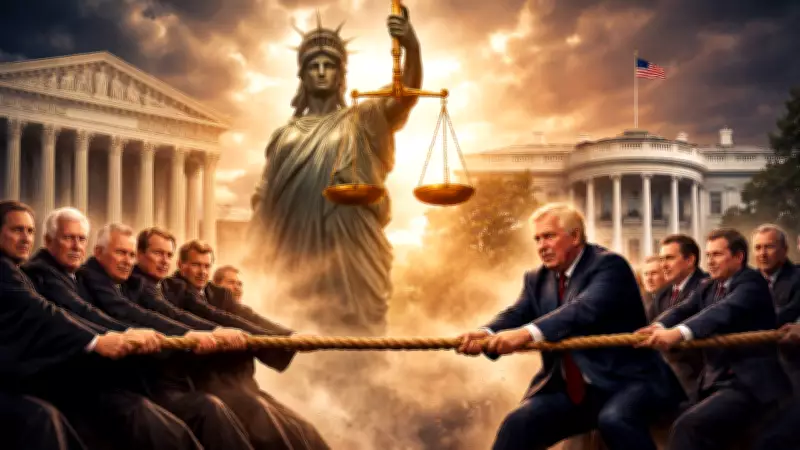
The Enduring Clash: How US Presidents Have Tested the Limits of Supreme Court Authority
"You can't always get what you want..." These iconic Rolling Stones lyrics resonate profoundly in Washington's political arena, where presidential ambitions often collide with judicial boundaries. The recent actions of former President Donald Trump, who imposed global tariffs after the Supreme Court struck down his earlier measures, exemplify a timeless American pattern. This confrontation is not an isolated incident but a recurring theme woven into the nation's constitutional fabric.
Marbury v Madison: The Foundation of Judicial Power
In 1803, the landmark case of Marbury v Madison quietly revolutionized American governance. Chief Justice John Marshall's strategic ruling established the Supreme Court as the ultimate interpreter of the Constitution, granting it the power of judicial review. While President Thomas Jefferson avoided a direct defeat, the judiciary emerged stronger, permanently altering the separation of powers and enabling the Court to invalidate acts of Congress and executive actions.
Andrew Jackson vs the Court: Defiance and Disregard
Nearly three decades later, President Andrew Jackson starkly ignored the Supreme Court's ruling in Worcester v Georgia. The Court had affirmed Native American tribes' rights under federal treaties, but Jackson, prioritizing westward expansion, sided with Georgia. His refusal to enforce the decision exposed a harsh reality: judicial authority relies on executive cooperation, and without it, rulings can become powerless, as tragically seen in the Trail of Tears.

Lincoln vs Taney: Wartime Powers Under Scrutiny
During the Civil War, President Abraham Lincoln suspended habeas corpus to detain Confederate sympathizers, a move challenged by Chief Justice Roger B. Taney in Ex parte Merryman. Lincoln ignored the ruling, arguing that national emergencies required extraordinary measures. This confrontation blurred constitutional lines, expanding presidential power in wartime and sparking enduring debates over liberty versus security.
FDR vs the Supreme Court: The Court-Packing Controversy
In the Great Depression era, President Franklin D. Roosevelt faced repeated setbacks as the Supreme Court struck down New Deal programs. Frustrated, he proposed adding younger justices to the bench, a plan critics labeled "court-packing." Though Congress rejected it, political pressure soon led the Court to shift its stance, upholding economic regulations and demonstrating how constitutional interpretation can evolve under political influence.
Truman vs the Justices: Limits on Emergency Powers
During the Korean War, President Harry S. Truman seized steel mills to prevent strikes, but the Supreme Court ruled against him in Youngstown Sheet & Tube Co v Sawyer. Justice Robert H. Jackson's opinion outlined fluctuating presidential powers, emphasizing that unilateral actions without congressional support are invalid. This decision reinforced legislative authority and curbed executive overreach even in wartime.
Nixon vs the Rule of Law: The Watergate Fallout
The Watergate scandal culminated in United States v Nixon, where the Supreme Court unanimously rejected President Richard Nixon's claim of absolute executive privilege. Forced to release Oval Office tapes, Nixon's involvement in obstruction of justice was revealed, leading to his resignation. This ruling affirmed that no president is above the law, and the judiciary can compel evidence from the executive branch.
Bush vs the Court: War on Terror and Judicial Oversight
After 9/11, President George W. Bush authorized military commissions at Guantánamo Bay, but the Supreme Court intervened in cases like Hamdan v Rumsfeld and Boumediene v Bush. These rulings asserted that detainees retain constitutional rights and that executive actions, even in national security matters, require congressional authorization and judicial review, preventing unchecked power.

Biden vs the Supreme Court: Modern Policy Constraints
Recently, President Joe Biden has faced a Supreme Court invoking the major questions doctrine to limit agency actions. In West Virginia v EPA and Biden v Nebraska, the Court struck down environmental and student loan policies, insisting that transformative decisions require clear congressional approval. This modern shift underscores that presidential power operates within judicially enforced limits, continuing the constitutional tug-of-war.
Conclusion: From Jefferson to Biden, the clash between executive ambition and judicial authority remains a defining feature of American democracy. Each confrontation reinforces the delicate balance of power, reminding us that while presidents push boundaries, the Supreme Court stands as a crucial check, ensuring governance within constitutional frameworks.