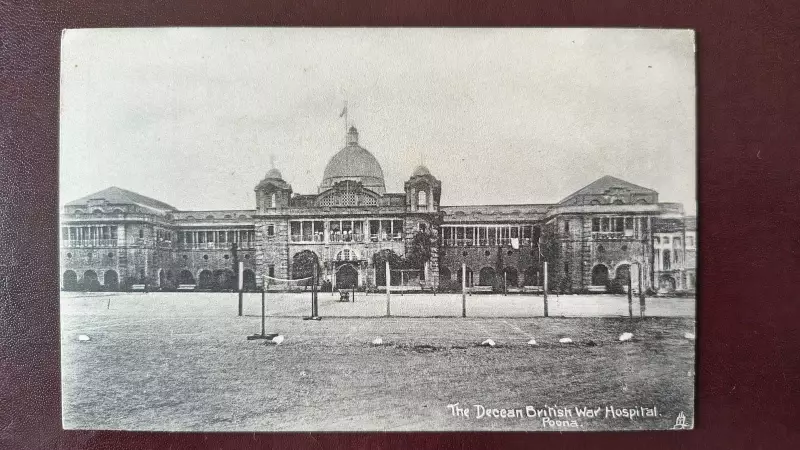
Nestled within Pune's academic landscape lies an institution with a past far richer than its agricultural mandate suggests. The College of Agriculture, established in 1907 as one of India's pioneering five agricultural colleges, holds within its grand walls a hidden narrative of wartime healing and historic visits, including one by Muhammad Ali Jinnah.
A Monument Transformed: The Deccan British War Hospital
Between 1916 and 1919, the college's iconic main building underwent a dramatic transformation. It was repurposed into the Deccan British War Hospital, Poona, to treat soldiers of the British Empire wounded in the Mesopotamian campaign of World War I, in present-day Iraq.
Architectural historian Pushkar Sohoni notes that convalescing patients and prisoners of war were shipped from the front to various hospitals in British India, including this one. The main building was fitted to accommodate over a thousand beds. An intriguing detail of this period is that while the doctors were English, the nursing staff was provided by the Australian Army Nursing Service.

References to this chapter are found in early 20th-century obituaries and books like Nightingales in the Mud, which documents the experiences of Australian nurses. Their letters mention landmarks like the Governor's mansion, now part of Savitribai Phule Pune University (SPPU).
Echoes of History in the Grand Hall
Today, the college's central hall under the dome is a hub of student activity, famously featured as a hospital in the film Munnabhai MBBS. However, its walls whisper stories of a different era. A marble bust of Sir Leslie Orme Wilson, Governor of Bombay, commemorates the first agricultural show held in Poona in 1926.
More surprising is a roll call of chief guests for the institute's social gatherings. The list, beginning with W.H. Sharp in 1909, includes a notable entry for M.A. Jinnah in 1917. Other distinguished names on the board include Jagjivan Ram in 1967 and military legend Lt Gen Shankarrao Pandurang Patil Thorat.
Roots in Reform and a Focus on Food Security
The college's origins are deeply tied to social reform and scientific advancement. It began as a Department of Agricultural Science at Pune's College of Science in 1879, gaining independent status in 1908. Its establishment was influenced by the advocacy of Mahatma Jyotiba Phule, who urged the British government to create agricultural education institutes.
Inaugurated by Lord Sydenham, the Governor of Bombay, in 1911, the college emerged when the importance of food security was gaining recognition. Sir Richard Temple, then Governor of Bombay Province, was instrumental in its founding. The institution celebrated its centenary in 2007 and is now officially known as Mahatma Phule Krishi Vidyapeeth.
Sohoni explains that Pune's temperate climate and, crucially, a secured water supply from the Khadakwasla dam via the Mula Left Bank canal made it an ideal location for agricultural research. Remarkably, even during its stint as a war hospital, the college continued its core educational and research functions, steadfastly advancing its original mission of improving India's food security.