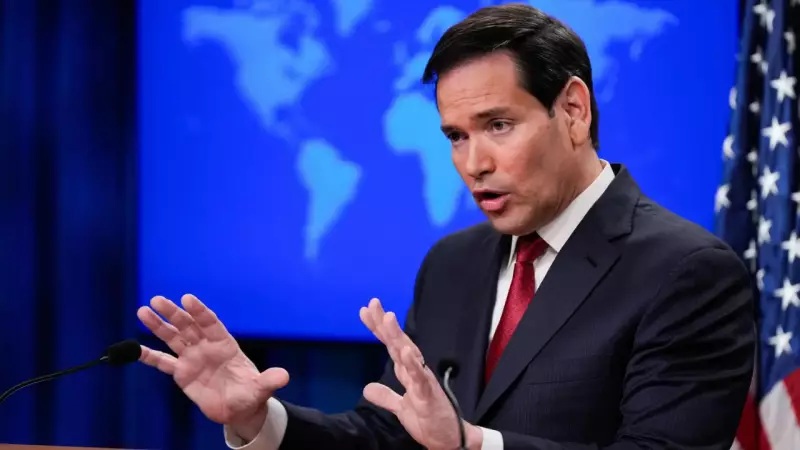
In a firm defence of recent US actions targeting Venezuela's oil industry, Secretary of State Marco Rubio has framed the move as a matter of hemispheric security, directly challenging the involvement of nations like China, Russia, and Iran. The remarks came during an interview with NBC News on Sunday, where Rubio articulated a clear 'America's backyard' doctrine.
Hemispheric Sovereignty and Oil Control
When questioned about the necessity of targeting Venezuela's oil sector if the primary goal was to bring deposed leader Nicolas Maduro to justice, Rubio's response was unequivocal. "This is western hemisphere. This is where we live," he stated, drawing a stark geographical line. He asserted that the United States possesses ample oil reserves and does not require Venezuela's resources for energy security. Instead, the core issue is control. "What we are not going to allow is the oil industry of Venezuela to be run by adversaries of the United States," Rubio declared.
He pointedly questioned the motives of other global powers invested in Caracas. "You have to understand, why does China need their oil? Why does Russia need their oil? Why does Iran need their oil? They are not even on this continent," he argued. Rubio positioned the US action as a protective measure for the Venezuelan people, claiming the objective is to ensure the proceeds from the nation's vast oil wealth benefit its citizens, not foreign governments.

Linking Foreign Involvement to Regional Crisis
Rubio directly connected the involvement of these external actors to the profound humanitarian and political crisis that has engulfed Venezuela and spilled over its borders. He pinned the blame for the mass migration exodus from Venezuela, which began around 2014, on this foreign interference, describing it as a primary source of regional destabilization.
"This is deeply destabilizing stuff. It's not going to continue to happen!" he warned. Emphasizing the Trump administration's stance, he added, "They are not going to come from outside of our hemisphere, destabilize our region in our own backyard and we have to pay the price for it. Not under President Trump!" This rhetoric underscores a policy aimed at preventing the Western Hemisphere from becoming a "base of operation" for US rivals and competitors.
On Congressional Approval and Mission Nature
Addressing potential constitutional concerns about the operation's authorisation, Rubio dismissed the need for prior Congressional approval. He categorised the mission as distinct from a full-scale military invasion or an extended campaign. "This was not an action that required congressional approval... This was not an invasion. This was not an extended military operation," he explained.
He characterised it instead as a "very precise operation" that was completed within a couple of hours and required specific, delicate conditions to be met. "We could not afford leaks, we could not afford anything that would have put our mission in jeopardy," Rubio stated, highlighting the covert and time-sensitive nature of the action. This justification seeks to place the operation in a legal and operational category that bypasses traditional war powers debates.