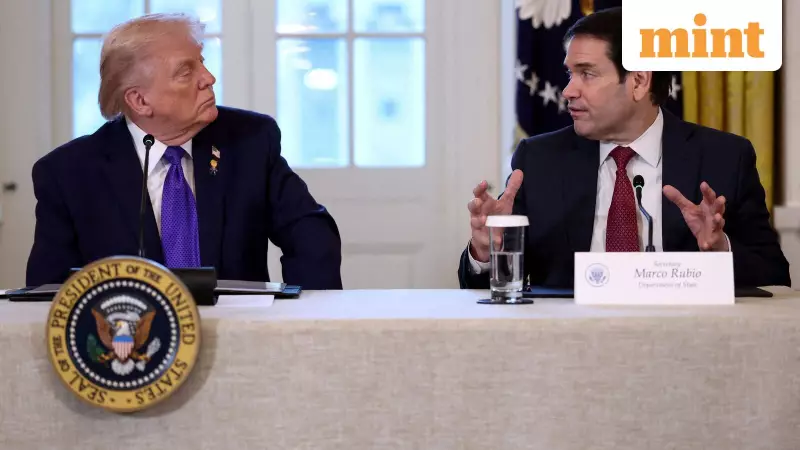
The political landscape of Latin America is witnessing seismic shifts, bringing a childhood fantasy of a top US official sharply into focus. US Secretary of State and National Security Advisor Marco Rubio, the son of Cuban immigrants, once dreamt of leading a "free Cuba." This personal history now carries profound geopolitical weight as the Trump administration turns up the heat on Havana following large-scale military action against its key ally, Venezuela.
From Boyhood Boast to Central Role in US Strategy
Long before he became a pivotal figure in American foreign policy, Marco Rubio harboured a deeply personal ambition regarding Cuba. In his 2012 memoir, "An American Son," written after his election to the US Senate, Rubio recalled telling his grandfather that he would "someday lead an army of exiles to overthrow Fidel Castro and become president of a free Cuba." This boyhood bravado is no longer just a family anecdote.
Rubio reportedly played a central role in the operation that led to the capture of former Venezuelan President Nicolás Maduro on January 3, 2026. According to CNN sources, in the months preceding the strike, Rubio was huddled at the White House with Stephen Miller, Trump's deputy chief of staff, to craft the strategy. The operation also resulted in the deaths of 32 Cuban nationals, further straining ties.

Trump's Warning and Cuba's Precarious Economic Lifeline
In the aftermath of the Venezuela strikes, President Donald Trump has directly targeted Cuba. On a recent Sunday, he took to Truth Social to urge the island nation to "make a deal before it's too late." He explicitly warned that the flow of Venezuelan oil and money would now cease, applying maximum economic pressure.
This threat strikes at the heart of Cuba's survival. Venezuela, a decades-long ally, has been supplying Cuba with roughly 35,000 barrels of oil per day, as per a BBC report. With the US exerting control over Venezuela's resources, Cuba has abruptly lost one of its principal economic patrons and energy suppliers. Experts cited by AP warn that a sudden halt in these oil shipments could trigger widespread social unrest and a mass migration crisis from Cuba.
A Legacy of Tension and a Future of Uncertainty
US-Cuba relations have been fraught since Fidel Castro overthrew a US-backed government in 1959. While efforts under former President Barack Obama thawed ties, the Trump administration has aggressively reversed course. Shortly after being sworn in for his second term, Trump reinstated Cuba's designation as a state sponsor of terrorism, a label Joe Biden had lifted just days prior.
The current crisis compounds existing hardships in Cuba. Even before the January 3rd attack, the nation was grappling with severe blackouts, long queues for fuel and food, and its worst economic crisis in decades. The sentiment of desperation is palpable among its citizens. 16-year-old student Amanda Gómez told AP, "I'd be lying if I told you that I don't want to leave the country. We're all thinking about leaving, from the youngest to the oldest."
The convergence of Rubio's personal history, aggressive US policy in Venezuela, and Cuba's economic vulnerability creates a volatile scenario. The question now is whether Trump's pressure will force a political deal or push a struggling nation into deeper chaos, potentially making an old dream for some a new nightmare for many.