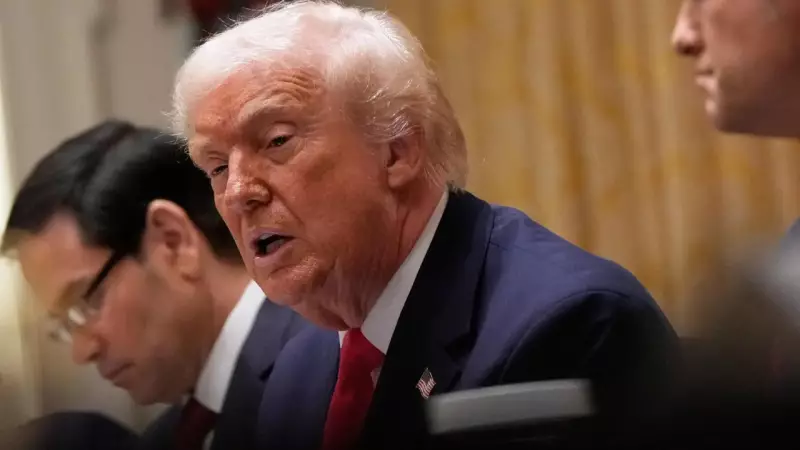
The United States Supreme Court has taken up a pivotal case that will determine the constitutionality of former President Donald Trump's executive action aimed at terminating birthright citizenship. The court's decision, anticipated by the end of June, could fundamentally alter a core principle of American immigration and citizenship law that has stood for over a century.
The Executive Order and Immediate Legal Backlash
On his first day back in office after securing a second term in November 2024, President Trump signed an executive order targeting birthright citizenship. The order sought to strip automatic citizenship rights from children born in the US to undocumented immigrants and certain temporary foreign residents. This policy, if enacted, would have put the citizenship status of hundreds of thousands of children born annually in the country at risk.
However, the move faced instant and widespread legal challenges. Federal judges in Washington, Maryland, and Massachusetts swiftly blocked the order from taking effect nationwide. One notable ruling came from Federal District Judge John C. Coughenour in Seattle, who labeled the executive action as "blatantly unconstitutional," a statement highlighted by the New York Times.

The 14th Amendment and the Core of the Dispute
The legal battle centres on the interpretation of the 14th Amendment to the US Constitution, ratified in 1868 after the Civil War. The amendment clearly states: "All persons born or naturalized in the United States, and subject to the jurisdiction thereof, are citizens of the United States and of the State wherein they reside." This clause has been understood since an 1898 Supreme Court ruling to guarantee citizenship to nearly all individuals born on American soil, irrespective of their parents' immigration status.
Trump and his allies have contested this long-standing application. They argue that the amendment's original intent was solely to grant citizenship to children of formerly enslaved people and has been incorrectly extended to cover the children of undocumented migrants. Once a fringe legal theory, this view has gained traction in conservative circles following Trump's endorsement. "We're going to have to get it changed," Trump asserted in a post-election interview with NBC News. "We're going to end that because it's ridiculous."
National Implications and Awaiting the Final Verdict
The White House, representing the Trump administration, has expressed its readiness to defend the policy. "The Trump Administration looks forward to making its case on the issue of birthright citizenship on behalf of the American people," stated White House spokesperson Abigail Jackson to NBC News.
The Supreme Court's decision to hear the case elevates it to a historic level. Birthright citizenship is a rare practice among developed nations and is considered a bedrock of American national identity. The final ruling from the nation's highest court will provide a definitive answer on whether a president can, via executive order, override the 14th Amendment's citizenship guarantee. The outcome of the New Hampshire case, expected by the end of June 2025, will therefore have profound and lasting consequences for the definition of American citizenship.