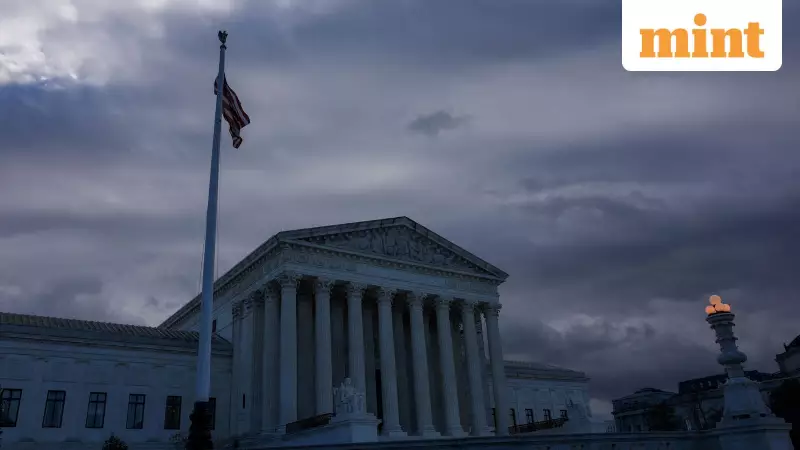
In a major development with potential global ramifications, the United States Supreme Court has agreed to hear a case that will determine the legality of former President Donald Trump's controversial policy aimed at limiting birthright citizenship. The justices announced on Friday that they will take up the Justice Department's appeal, with arguments scheduled for the current term and a final ruling expected by the end of June 2025.
The Core Legal Battle Over the 14th Amendment
The case centres on an executive order signed by Donald Trump on January 20, 2025, his first day back in office for a second term. The policy directed US agencies to deny automatic citizenship to children born in the country if neither parent is an American citizen or a lawful permanent resident (green card holder). This directive was immediately challenged in lower courts, which ruled it unlawful.
The legal opposition argues that Trump's order blatantly violates the US Constitution's 14th Amendment, ratified in 1868. The amendment's Citizenship Clause states that all "persons born or naturalised in the United States, and subject to the jurisdiction thereof, are citizens of the United States." For over a century, this has been interpreted as guaranteeing citizenship to anyone born on US soil, regardless of their parents' immigration status.

However, the Trump administration contends that the phrase "subject to the jurisdiction thereof" excludes children of immigrants who are in the US illegally or on temporary visas, such as students or workers. They argue citizenship should only apply to children of those whose "primary allegiance" is to the United States, established through "lawful domicile."
What the Challengers and Supporters Say
The policy has faced fierce legal challenges. A coalition of states—Washington, Arizona, Illinois, and Oregon—filed one lawsuit, while a separate class-action suit was brought in New Hampshire by affected families. Lower courts, including the San Francisco-based 9th US Circuit Court of Appeals, sided with the challengers, blocking the policy nationwide.
Cecillia Wang, national legal director of the American Civil Liberties Union representing the plaintiffs, stated, "No president can change the 14th Amendment's fundamental promise of citizenship." The challengers cite the landmark 1898 Supreme Court case United States v. Wong Kim Ark, which they say settled the issue of birthright citizenship for children of non-citizen parents.
Conversely, the Trump administration asserts the policy is crucial for national security. White House spokesperson Abigail Jackson said, "This case will have enormous consequences for the security of all Americans, and the sanctity of American citizenship." The administration claims the current interpretation encourages "birth tourism" and illegal immigration.
A Long Road to the Supreme Court
This is not the first time the birthright citizenship fight has reached the nation's highest court. Earlier in 2024, the Supreme Court issued a 6-3 ruling that limited the power of federal judges to issue nationwide injunctions against presidential policies, but it did not address the core legality of Trump's order. That ruling left the door open for class-action lawsuits, which is precisely the path that has now led the justices to take up the substantive constitutional question.
By agreeing to hear the class-action case from New Hampshire before a Boston-based appeals court could review it, the Supreme Court signalled the urgency and national importance of resolving this deep legal divide. The outcome of this case will definitively shape the interpretation of a foundational amendment and determine the citizenship rights of thousands of children born in the United States annually.
The Supreme Court's decision, expected by late June 2025, will have profound implications for US immigration law, constitutional interpretation, and the lives of countless families.