

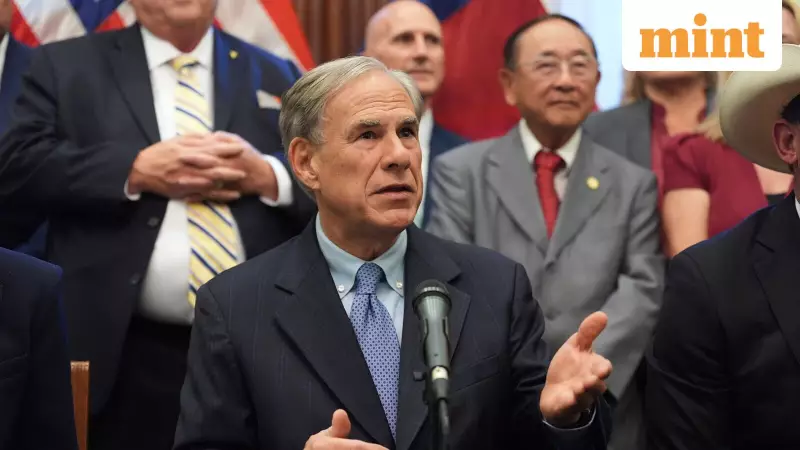
Texas Governor Implements Dual Policy: H-1B Visa Freeze and Chinese Tech Ban
In a significant policy announcement on Tuesday, Texas Governor Greg Abbott unveiled two major directives aimed at reshaping employment and technology procurement within state systems. The governor ordered an immediate freeze on H-1B visa petitions for state agencies and public universities while simultaneously announcing a comprehensive ban on China-linked technology companies from state infrastructure.
"Texans Come First" Employment Initiative
Governor Abbott made his position clear through a social media post stating "Texans come first" as he announced the H-1B visa freeze. The governor emphasized that Texas taxpayers invest billions in workforce training and development, arguing that these investments should primarily benefit qualified Texas residents rather than foreign workers.
"I'm directing state agencies and universities to freeze new H-1B visa petitions," Abbott declared. "Texas taxpayers invest billions to train our workforce. Those jobs should go to Texans."

Rationale Behind the H-1B Visa Freeze
In a detailed letter addressed to heads of state agencies, Governor Abbott explained his decision was prompted by multiple factors. He cited "recent reports of abuse in the federal H-1B visa program" and referenced the federal government's ongoing review of the program designed to ensure American jobs go to American workers.
The governor expressed concern that the H-1B program has strayed from its original purpose. "Evidence suggests that bad actors have exploited this program by failing to make good-faith efforts to recruit qualified U.S. workers before seeking to use foreign labor," Abbott wrote in his official correspondence.
He further elaborated that "rather than serving its intended purpose of attracting the best and brightest individuals from around the world to our nation to fill truly specialized and unmet labor needs, the program has too often been used to fill jobs that otherwise could — and should — have been filled by Texans."
Specific Requirements of the H-1B Order
The governor's directive establishes several specific requirements for state agencies and public institutions of higher education:
- No state agency or public university can petition for new H-1B workers without written permission from the Texas Workforce Commission
- All agencies and universities must report by March detailing how many new H-1B petitions and renewal requests they submitted during the previous year
- Institutions must disclose how many H-1B visa holders they currently sponsor, including comprehensive details about workers' home countries, current occupations in Texas, and documentation demonstrating efforts to provide qualified Texans with reasonable opportunities to apply for the same positions
Current H-1B Employment Landscape in Texas
According to data from the U.S. Federal government, the majority of H-1B visa holders in Texas work within the private sector. The top employers of H-1B beneficiaries include:
- Cognizant Technology Solutions US Corp (3,172 H-1B beneficiaries)
- Infosys Limited (2,856 H-1B beneficiaries)
- Oracle America Inc (2,690 H-1B beneficiaries)
- Cognizant Technology Solutions US (additional 1,172 H-1B beneficiaries)
- Tesla, owned by Elon Musk (1,094 H-1B beneficiaries)
Other significant employers of H-1B visa workers in Texas include Charles Schwab and Company (574), AT&T (487), KPMG (294), HP (290), and Caterpillar (285). While private sector companies remain exempt from the governor's directive, public universities and hospitals are expected to face the most significant impact, with many institutions employing hundreds of H-1B workers in specialized roles.
Ban on China-Linked Technology Companies
In a parallel move, Governor Abbott announced a comprehensive ban on China-linked technology companies from state systems. The governor stated this measure aims to prevent these firms from harvesting data on Texas residents and exploiting state infrastructure for potentially malicious purposes.
The new restrictions will apply to 26 specific companies, including prominent names such as:

- Alibaba
- Shein
- Hisense
- PDD (which operates the e-commerce platform Temu)
This dual announcement represents a significant shift in Texas policy regarding both employment practices and technology procurement, with potential implications for the state's workforce development and technological infrastructure moving forward.





