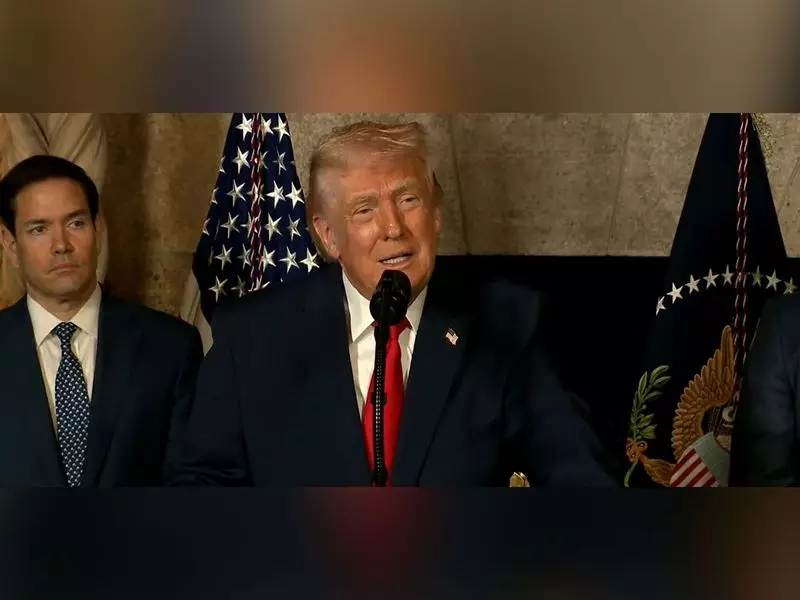
Former US President Donald Trump has publicly suggested that it would be a wise move for Venezuela's leader, Nicolas Maduro, to relinquish his position. This advice came during a recent interview, where Trump linked the future of Venezuela to the outcome of the upcoming American presidential election.
Trump's Direct Advice to the Venezuelan Leader
In his remarks, Trump stated clearly that it would be a smart decision for Nicolas Maduro to leave his post. He framed this not just as a political opinion but as a strategic recommendation for the Venezuelan president. The context of this advice is deeply intertwined with US politics. Trump indicated that if he wins the November election, the situation for Maduro could become significantly more challenging.
The former president contrasted this with the current administration under Joe Biden, implying a softer approach. Trump's message was unambiguous: stepping down voluntarily might be the most prudent path forward for the Venezuelan leader given the potential change in Washington's stance.

The Stakes of the Upcoming US Election
The core of Trump's argument hinges on the November US presidential election. He positioned himself as taking a far tougher line on Venezuela compared to President Biden. According to Trump, his return to the Oval Office would lead to a dramatic shift in policy, increasing pressure on the Maduro government.
This isn't the first time Trump has addressed Venezuela's political crisis. During his previous term from 2017 to 2021, his administration imposed severe sanctions on the country's vital oil industry and recognized opposition figure Juan Guaido as the legitimate interim president. These moves were part of a maximum pressure campaign aimed at ousting Maduro, whom the US and dozens of other nations consider illegitimate following the 2018 elections widely condemned as fraudulent.
Background of the Venezuela Political Standoff
The political situation in Venezuela has been deadlocked for years. Nicolas Maduro has maintained control over the government and the military despite a deep economic crisis and widespread international condemnation. The United States, under both Trump and initially under Biden, has led efforts to isolate his regime diplomatically and economically.
However, there have been recent shifts. The Biden administration, seeking to address the humanitarian crisis and migration issues, has eased some oil sanctions on Venezuela. This move was contingent on Maduro's government committing to holding free and fair presidential elections in 2024. While this provided temporary relief, the fundamental political conflict remains unresolved, with Maduro showing every intention of staying in power.
Trump's latest comments throw this delicate situation into sharper relief. They signal a potential return to a more confrontational and aggressive US foreign policy towards Caracas if he secures a second term. This prospect adds another layer of uncertainty for a nation already struggling with immense challenges.
The international community continues to watch Venezuela closely. The country's future leadership and its relationship with global powers like the United States hang in the balance, influenced by both its internal dynamics and external political events like the American election in November.