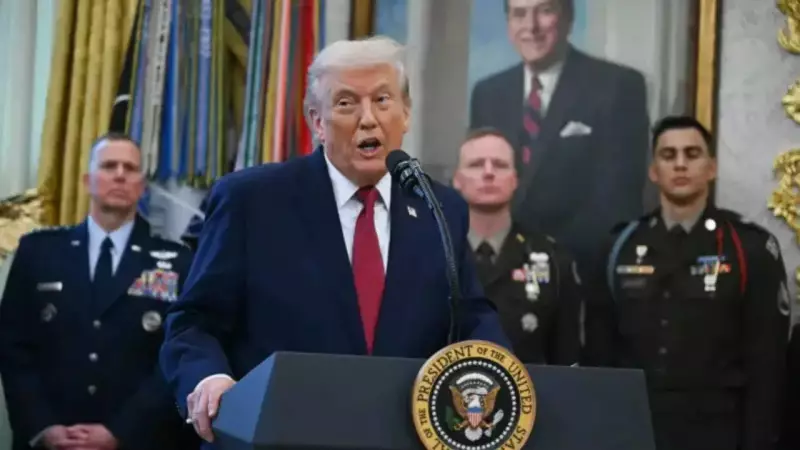
In a significant move to intensify the war on drugs, US President Donald Trump declared his intention to classify the synthetic opioid fentanyl as a "weapon of mass destruction." The announcement was made on Monday (local time) from the Oval Office during a ceremony honouring troops deployed at the US-Mexican border.
A Lethal Threat to National Security
President Trump framed the fentanyl crisis as a direct assault on American citizens by foreign adversaries. "There's no doubt that America's adversaries are trafficking fentanyl into the United States in part because they want to kill Americans," he stated. Drawing a stark parallel, he added, "If this were a war, that would be one of the worst wars." He bolstered his argument by referencing historical instances, including China's past struggles with opium, suggesting that nations use drugs to weaken and dominate others.
The Staggering Human Cost and Smuggling Routes
The President's drastic proposal is backed by grim statistics. He revealed that fentanyl has claimed nearly 330,000 American lives in the five-year period ending in April this year. While acknowledging the drug's legitimate medical applications, Trump emphasised its extreme danger, as it can be lethal even in minuscule doses. The primary channels for this illicit substance entering the United States are through the porous Mexican border and via international mail and shipping systems, making interdiction a complex challenge.

Implications and International Context
Although the specific legal and policy ramifications of designating fentanyl a weapon of mass destruction were not immediately detailed, experts suggest it could pave the way for harsher criminal penalties for traffickers and potentially mobilise additional national security resources. This announcement comes in the wake of Trump's October meeting with Chinese President Xi Jinping, where Xi reaffirmed commitments to curb the flow of fentanyl precursors. Similar promises had been made to Trump during his first term and to current President Joe Biden.
The move signals a hardening of the US administration's stance, treating the opioid epidemic not just as a public health crisis but as an act of aggression requiring a robust, security-focused response. The global community, particularly nations involved in the chemical supply chain, will be watching closely as this new classification takes shape.