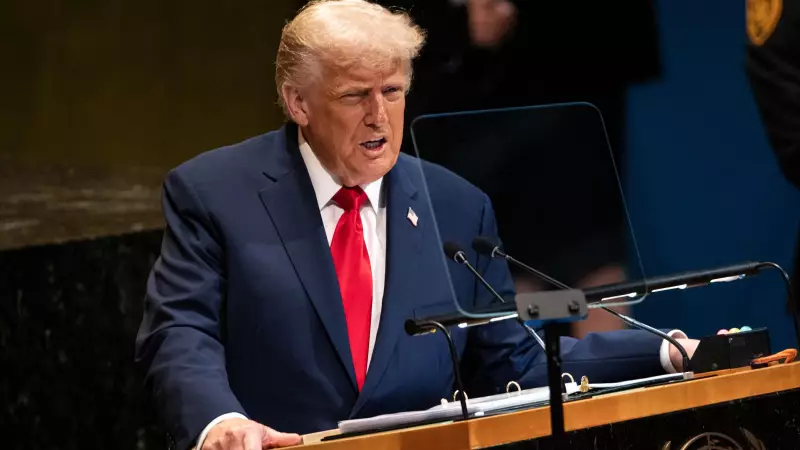
Former US President Donald Trump has ignited fresh controversy with a striking characterisation of his country's demographic landscape. During a recent campaign rally, Trump declared that the United States has effectively transformed into a 'real United Nations' due to the influx of people from across the globe. This statement, made in the heat of the 2024 presidential race, offers a new lens on his long-standing immigration rhetoric and its implications for American identity.
The Rally Remarks and a Shift in Tone
Addressing supporters in Wisconsin, Trump presented his observation about the US becoming a microcosm of the world body. 'Our country is being destroyed,' he stated, framing the demographic change as a consequence of failed policies. However, analysts noted a nuanced shift; while the comment carried his typical critical edge regarding current immigration flows, it also implicitly acknowledged the nation's foundational diversity.
This rhetorical move is seen as part of a broader strategy. Trump contrasted this 'United Nations' scenario with his own administration's record, pledging to implement what he termed the 'largest domestic deportation operation' in American history if re-elected. He positioned this as a necessary corrective measure, arguing it would address issues ranging from economic pressure on public services to national security.

Context and Campaign Strategy
The remark did not emerge in a vacuum. It comes amidst a fiercely contested election where immigration remains a top-tier issue for Republican voters. Trump's narrative consistently paints a picture of a nation under siege, with porous borders allowing unchecked entry. His 'United Nations' analogy serves to amplify the scale and diversity of the immigration he criticises, suggesting a transformation so profound it mirrors the entire international community.
Critics were quick to respond. They argue that the United States has always been a nation of immigrants, and Trump's framing is deliberately alarmist. They point out that his proposed mass deportation plans raise serious humanitarian and logistical concerns. Furthermore, his comments are viewed as potentially alienating to the very immigrant communities and their descendants who form a vital part of the American social and economic fabric.
Implications for Policy and Global Perception
The consequences of this rhetoric extend beyond campaign soundbites. Trump's statement signals the potential for a dramatic reversal of current US immigration policy should he return to the White House. The promise of a historic deportation drive suggests a governance model prioritising enforcement and exclusion, a stark contrast to more integration-focused approaches.
Internationally, such a stance could strain diplomatic relations, particularly with countries whose citizens are affected. The 'United Nations' comment also reflects on America's global image. While some supporters may see it as a call to preserve a distinct national character, others interpret it as a rejection of the multicultural ideals often associated with American soft power. The debate underscores a deep and enduring conflict over what defines the United States in the 21st century.
As the 2024 election progresses, Trump's characterisation of America as a 'real United Nations' will likely remain a focal point. It encapsulates a core pillar of his campaign: a promise to radically reshape the nation's demographic and immigration policies. Whether this message resonates as a warning or backfires as a divisive tactic is a question only the voters can answer in November.