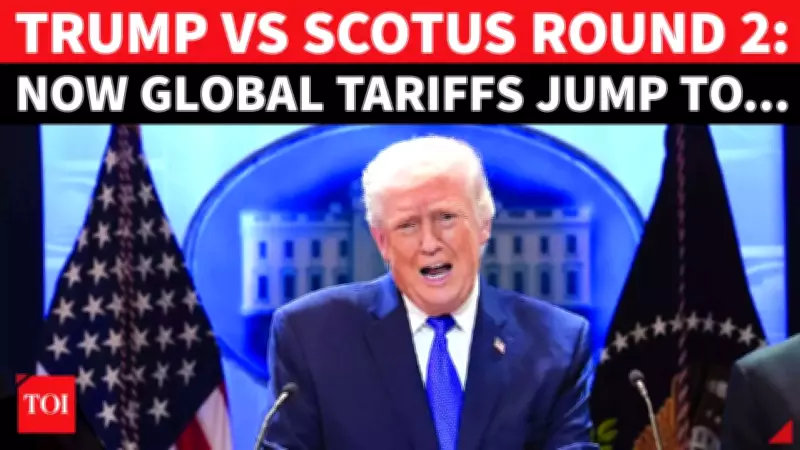
Trump Defies Supreme Court Ruling, Imposes 15% Global Tariffs in Escalating Trade War
In a dramatic escalation of international trade tensions, President Donald Trump has unilaterally imposed sweeping 15 percent tariffs on all countries, directly challenging a landmark Supreme Court decision that struck down the legal foundation of his trade measures just one day earlier.
Supreme Court Delivers Blow to Presidential Authority
The constitutional confrontation began when the United States Supreme Court, in a decisive 6-3 ruling, declared that President Trump had exceeded his executive authority under the International Emergency Economic Powers Act. Chief Justice John Roberts, writing for the majority, emphasized that only Congress possesses the constitutional power to authorize such extraordinary trade measures, delivering a significant check on presidential power.
The ruling specifically targeted Trump's previous trade policies, which the Court found lacked proper congressional authorization. Legal experts immediately noted this as one of the most significant limitations on presidential trade authority in decades, setting a precedent that could affect future administrations.

Immediate Presidential Response and Escalation
Within hours of the Supreme Court's decision, President Trump signed a new executive order imposing an initial 10 percent tariff on all imported goods from every trading partner. Demonstrating his determination to push forward with his trade agenda, the administration then escalated this measure further, officially announcing the increase to 15 percent across the board.
This rapid sequence of events—from judicial rebuke to executive action—has created unprecedented constitutional tensions between the judicial and executive branches. The White House has framed the move as necessary for national economic security, while critics argue it represents a direct challenge to the separation of powers established in the U.S. Constitution.
Global Economic Implications and Potential Retaliation
The imposition of universal 15 percent tariffs has sent shockwaves through global markets and diplomatic circles. Economists warn that such broad tariffs could trigger:
- Immediate increases in consumer prices across multiple sectors
- Disruption of global supply chains that have developed over decades
- Potential retaliatory measures from trading partners worldwide
- Increased volatility in financial markets already nervous about trade tensions
International leaders have expressed deep concern about the stability of the global trading system, with many preparing coordinated responses. The move comes at a particularly sensitive time for the world economy, which has been struggling with inflationary pressures and geopolitical uncertainties.
Constitutional Crisis and Political Fallout
The confrontation between the Supreme Court and the executive branch raises fundamental questions about constitutional limits in the United States. Legal scholars are debating whether Congress will need to take immediate action to clarify presidential trade authority, or whether further litigation will be necessary to resolve this constitutional standoff.
Political reactions have been sharply divided along partisan lines. Supporters of the administration argue that strong executive action is necessary to protect American industries and workers, while opponents characterize the move as an unconstitutional overreach that undermines the rule of law and the balance of powers.
As the situation continues to develop, all eyes are on how trading partners will respond, how markets will adjust, and what legal or legislative actions might follow this unprecedented challenge to both judicial authority and global trade norms.