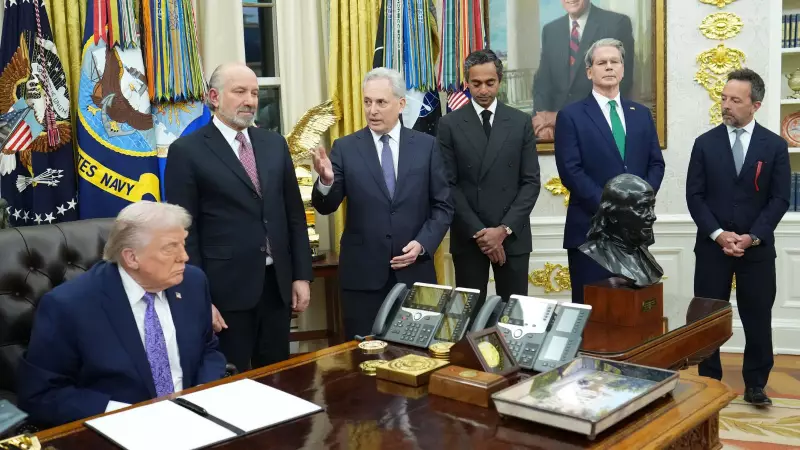
In a significant political pivot, the administration of President Donald Trump has delivered a series of major policy victories to the world's largest technology companies, aligning with their goals on artificial intelligence (AI) development and cryptocurrency regulation. This shift comes after an initial period of tension, marking a profound transformation in the relationship between the White House and Silicon Valley.
From Friction to Favour: The Tech Industry's Winning Streak
When President Trump returned to the Oval Office in January 2025, the tech industry's lavish inauguration donations and visits to his Mar-a-Lago estate in Florida seemed to have little immediate effect. The administration initially vowed to continue a legal fight to break up Meta, imposed tariffs affecting Apple's supply chains, and restricted exports of advanced AI chips made by companies like Nvidia.
However, the landscape changed dramatically by the summer. The Trump administration eliminated numerous limits on AI chip exports, fast-tracked permits for the data centres that power AI systems, and pushed through legislation granting federal approval to a specific type of cryptocurrency. In a decisive move this month, Trump signed an executive order to nullify AI restrictions set by individual states and even green-lighted sales of a more powerful Nvidia chip to China, America's top strategic rival.

"The conservative party stands for the free market and not picking winners and losers," said Isabel Sunderland, a technology policy expert at the nonpartisan group Issue One. "Yet what we've seen so far in the Trump administration is an administration that has picked the tech industry to win in ways that is contrary to his own base."
A Trillion-Dollar Alliance and Soaring Markets
This policy shift has catalysed an unprecedented investment boom. According to a tally by The New York Times, tech behemoths including Amazon, Apple, Google, Meta, Nvidia, OpenAI, and Oracle have announced a combined $1.4 trillion in spending on domestic data centres and manufacturing projects this year alone.
For Silicon Valley, the alliance has meant a financial bonanza. Companies like Alphabet, Amazon, Apple, Meta, Microsoft, Nvidia, and Tesla have seen their share prices soar, buoyed by industry-friendly policies and freedom from potential regulation. Bitcoin, the leading cryptocurrency, hit record highs. The industry can now develop AI with significantly fewer constraints.
White House spokesperson Liz Huston framed the relationship as a strategic necessity for national prosperity. "President Trump is leveraging his close relationships with private-sector titans to cement American technological dominance for the rest of the 21st century," she stated.
Internal GOP Rifts and Grassroots Backlash
This flourishing partnership, however, has driven a wedge through the political right, dividing Republican lawmakers and drawing sharp criticism from conservative think tanks and populist figures. Critics argue that Trump has allowed tech billionaires to wield excessive influence, crafting policies that further enrich the industry while neglecting safeguards for other Americans.
"Big Tech is not a natural ally to our coalition," asserted Wes Hodges, head of tech policy at the right-leaning Heritage Foundation. "Our work is to keep the memory of Big Tech and their unique concentration of power that is a threat against conservatives."
The backlash is not confined to think tanks. Florida Governor Ron DeSantis criticised efforts to curb state-level AI laws, asserting, "We have a right to do this." Georgia Representative Marjorie Taylor Greene echoed this sentiment on social media, emphasising that "States must retain the right to regulate and make laws on AI... Federalism must be preserved."
A November poll by the Institute for Family Studies found that 57% of American voters, including 43% of Trump voters, opposed federal actions to block state AI regulations.

Local Conflicts and Unaddressed Safety Concerns
The real-world impact of the tech boom is sparking local conflicts. The construction spree of energy- and water-intensive data centres by Meta, Amazon, Microsoft, and others has raised utility bills and environmental concerns. In Georgia, Democrats recently won seats on the state's utility commission by campaigning on affordability amidst the data centre boom.
In Port Washington, Wisconsin, three residents were arrested this month protesting a $15 billion data centre project by OpenAI and Oracle, fearing large tax breaks for the companies and strain on freshwater supplies. "There are lots of long-term costs for residents," said local resident Michael Beaster.
Furthermore, the alliance has overshadowed growing anxieties about AI's societal impact. Parents who have sued AI companies after their children died by suicide following interactions with AI chatbots are pleading for safety measures. "It should not be at odds to say we are pro-American AI and also need to protect kids," said Evan Swarztrauber of the Foundation for American Innovation.
Lifetime Republican Lori Schott from Colorado, who lobbied for child safety laws after her 18-year-old daughter's suicide linked to toxic social media content, expressed the dilemma of grassroots voters. "Our votes will reflect a party that puts kids' safety first," she stated, highlighting the struggle to reconcile the administration's friendliness with tech executives.
While the tech industry's aggressive lobbying—spearheaded by figures like White House AI and crypto czar David Sacks—has clearly paid off, the sustainability of this entente remains uncertain given Trump's unpredictable nature. The evolution of this powerful alliance continues to shape the future of critical technologies and is poised to be a defining issue in the upcoming midterm elections.