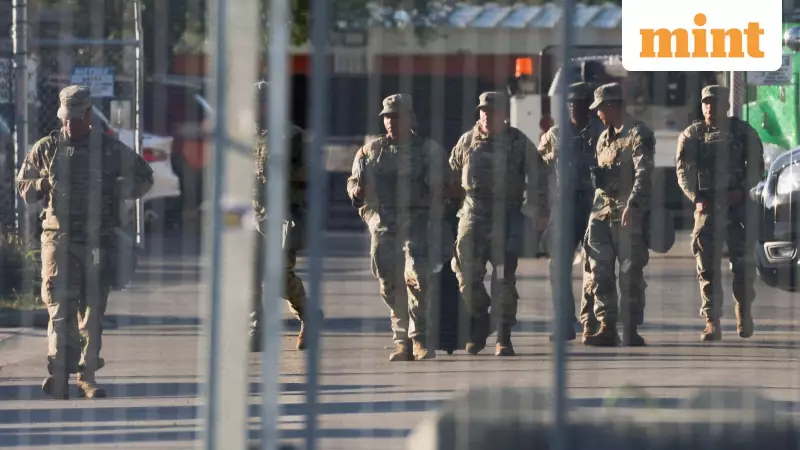
In a significant development, US President Donald Trump has announced a pause in his controversial push to deploy federalised National Guard troops to the cities of Chicago, Los Angeles, and Portland. The decision comes after the administration faced a series of legal setbacks in courts, highlighting the intense friction between federal authority and state rights.
Legal Roadblocks Force Presidential Pause
The move to deploy troops, which was strongly opposed by Democratic governors and local officials in the respective states, has been entangled in litigation. On Wednesday, Trump stated in a social media post, "We will come back, perhaps in a much different and stronger form, when crime begins to soar again - Only a question of time!" This statement underscores his persistent view of using federal force to combat crime in urban centres, a key plank of his second-term agenda.
Typically, National Guard units operate under the command of state governors. However, President Trump initiated their federalisation, arguing it was necessary for a wider effort against immigration, crime, and protests. The Associated Press reported that the president sees this tough-on-crime stance as a potent political issue ahead of next year's midterm elections.

Local Leaders Dispute Impact, Cite Own Efforts
The president claimed the troops' presence led to a drop in crime in the three cities. However, this assertion is contested. In Chicago and Portland, the guardsmen never actually patrolled the streets due to ongoing legal challenges. When the Chicago deployment was contested, a Justice Department lawyer clarified the mission was to protect federal properties and agents, not "solving all of crime in Chicago."
Local authorities credited their own strategies for reducing crime. Portland Mayor Keith Wilson's office stated reductions were due to local police and safety programs. Chicago officials echoed this, announcing on Tuesday that the city recorded 416 homicides in 2025, the lowest figure since 2014.
Governors Halt Federal Overreach
The legal resistance was formidable. In December, the Supreme Court refused to allow the deployment in the Chicago area, a rare judicial setback for the president. Illinois Governor JB Pritzker responded on social media, stating Trump "lost in court when Illinois stood up against his attempt to militarize American cities."
In Oregon, a federal judge permanently blocked the deployment in November after a trial. Governor Tina Kotek welcomed the pause, noting the troops "were never lawfully deployed to Portland and there was no need for their presence." Similarly, California Governor Gavin Newsom called the federal takeover of the state's Guard "illegal," stating, "About time he admitted defeat."
Deployments Continue Elsewhere Amid Political Divide
While the push in these three cities is paused, National Guard troops remain deployed in other locations under different circumstances. The U.S. Court of Appeals for the D.C. Circuit allowed troops to stay in Washington, D.C., where they were sent after Trump declared a "crime emergency" in August.
The deployment reveals a sharp political divide. A move to send the Tennessee National Guard to Memphis in September was supported by the state's Republican leadership but blocked by a judge, siding with Democratic officials. Conversely, the deployment of about 350 troops to New Orleans for Mardi Gras has backing from both the Republican governor and the city's Democratic mayor.
This episode underscores the ongoing tension between federal power and local autonomy in the United States. It sets a precedent for how crime-fighting initiatives can become battlegrounds for constitutional authority, with significant implications for the upcoming electoral cycle.