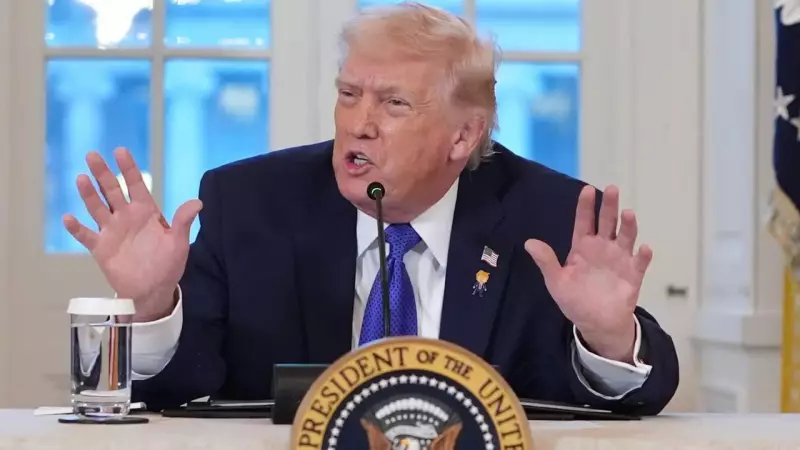
In a striking reaffirmation of his administration's strategic focus on the Arctic, former US President Donald Trump has once again declared his intention to take action regarding Greenland, warning that failure to do so would allow rivals Russia and China to establish a foothold. Speaking to reporters late on Friday during a meeting with top oil and gas executives, Trump framed the issue as an urgent national security imperative.
Trump's Stark Warning: 'Not Going to Have Russia or China as a Neighbour'
Trump dismissed Denmark's historical claim to the vast, resource-rich island, arguing that a landing 500 years ago does not confer ownership. "We are going to do something on Greenland, whether they like it or not," he stated emphatically. "Because if we don't do it, Russia or China will take over Greenland -- and we're not going to have Russia or China as a neighbour."
He presented a binary choice for the United States, suggesting a preference for a deal "the easy way" but vowing to proceed "the hard way" if necessary. Trump painted a picture of heightened military activity in the region, claiming, "if you take a look at outside of Greenland right now, they are Russian destroyers, Chinese destroyers and bigger there are Russian submarines all over the place."

When challenged on why the US needed ownership given its existing military presence in Greenland, Trump was unequivocal. "When we own it we defend it. You don't defend leases the same way. You have to own it," he asserted, linking the concept of ownership directly to national defence.
European Backlash and NATO Implications
Trump's repeated musings on acquiring Greenland have triggered a firm and serious response from Denmark and the semi-autonomous territory of Greenland itself. Danish Prime Minister Mette Frederiksen has previously rejected Trump's security rationale as an "unacceptable pleasure." The situation has escalated to the point where Copenhagen has reportedly instructed its troops in Greenland to adopt a "shoot first and ask questions later" stance if the territory comes under attack.
The remarks have sent shockwaves through the NATO alliance. When questioned about the potential of the US using force against another NATO member, Prime Minister Frederiksen warned, "If the US attacks another NATO country, everything stops." She underscored that while Washington's actions are unpredictable, "there is full support from Europe that borders must be respected."
Trump, however, countered by positioning himself as NATO's saviour, stating, "I'm all for NATO. I saved it. If it weren't for me, NATO would not be there." He also drew a parallel to recent US military action in Venezuela, suggesting it prevented Chinese or Russian dominance there.
Broader Context: Arctic Strategy and Energy Critique
This latest episode is not an isolated comment but part of a consistent pattern. Trump had famously offered to buy Greenland during his first term in 2019, an offer flatly rejected by Denmark. The Arctic has become a central theatre in great power competition, with Greenland's significant deposits of rare earth minerals, uranium, and iron adding to its geopolitical value.
During the same interaction, Trump launched a sharp critique of wind energy, a stance with implications for global climate agreements. "I'm not much of a windmill person," he said, claiming they lose money, destroy landscapes, kill birds, and are "all made in China." He accused China of selling wind turbines to "suckers like Europe" while relying on coal, oil, gas, and nuclear power domestically.
These comments followed his signing of a memorandum directing the US to withdraw from numerous international bodies deemed contrary to American interests. The list of affected organisations includes the India- and France-led International Solar Alliance, the Intergovernmental Panel on Climate Change, and the International Renewable Energy Agency.

The convergence of these statements—on territorial ambition, alliance politics, and energy policy—highlights a foreign policy approach that continues to prioritise unilateral action and great power rivalry, creating significant diplomatic friction with traditional European allies.