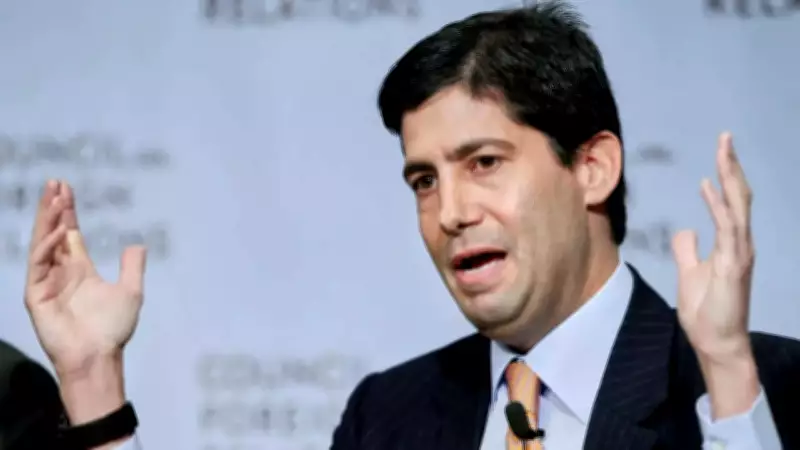
In a significant development for global economic governance, President Donald Trump has announced his nomination of Kevin Warsh to become the next chairman of the United States Federal Reserve. The appointment is expected to take effect in May this year, marking a leadership transition from the current Fed chief Jerome Powell.
A Presidential Selection Amidst Monetary Policy Tensions
Jerome Powell has faced considerable criticism from President Trump over recent months, with the President repeatedly expressing dissatisfaction with the pace and extent of interest rate reductions. The Federal Reserve chair position represents one of the most influential roles within the US government, wielding substantial authority over the direction of the world's largest economy.
Kevin Warsh's name had been circulating in speculation circles for some time, making Trump's formal announcement less surprising to political observers. The President took to his Truth Social platform to detail Warsh's extensive qualifications and rationale for the nomination.

Warsh's Impressive Professional Background
In his social media declaration, Trump highlighted Warsh's current positions as the Shepard Family Distinguished Visiting Fellow in Economics at the Hoover Institution and Lecturer at the Stanford Graduate School of Business. Additionally, Warsh serves as Partner of Stanley Druckenmiller at Duquesne Family Office LLC.
Educational and Professional Credentials:
- Bachelor's degree from Stanford University
- Juris Doctor from Harvard Law School
- Extensive research experience in Economics and Finance
- Author of an Independent Report to the Bank of England proposing monetary policy reforms in the United Kingdom, with Parliament adopting the recommendations
Warsh made history as the youngest Federal Reserve Governor ever at age 35, serving on the Board of Governors from 2006 to 2011. During his tenure, he represented the Federal Reserve at the G-20 and acted as the Board's Emissary to Emerging and Advanced Economies in Asia. He also served as Administrative Governor, overseeing the Board's operations, personnel, and financial performance.
Prior to his Federal Reserve appointment, from 2002 to 2006, Warsh worked as Special Assistant to the President for Economic Policy and Executive Secretary of the White House National Economic Council. His earlier career included a position in the Mergers & Acquisitions Department at Morgan Stanley & Co. in New York, where he served as Vice President and Executive Director.
Trump expressed confidence in his nominee, stating: "I have known Kevin for a long period of time, and have no doubt that he will go down as one of the GREAT Fed Chairmen, maybe the best."
Policy Divergence and Strategic Considerations
Despite the presidential endorsement, Warsh represents a somewhat unexpected choice given his monetary policy perspectives. As a former Federal Reserve governor, Warsh is widely regarded as an inflation hawk who resigned in 2011 after warning about excessive liquidity injections into the economy. He maintains a "hard money" stance that favors a strong dollar and restrained balance sheet approaches.
This orientation contrasts sharply with President Trump's typically dovish preferences regarding interest rates. Noted economist Paul Krugman observed this paradox in his blog, noting: "Warsh calls for tight money and opposes any attempt to boost the economy when Democrats hold the White House. Like all Trumpers, he has been all for lower interest rates since November 2024."
According to financial analysts, Trump's selection of Warsh may represent a strategic wager that someone with seemingly distant ideological positions could demonstrate greater adaptability once assuming the role. Warsh's professional trajectory—beginning as a young Wall Street executive, evolving into an independent-minded Fed governor, and subsequently affiliating with prominent policy institutions—creates a background likely to appeal to presidential considerations.

Family Connections and Additional Dimensions
The nomination carries additional layers of interest due to Warsh's family connections to President Trump. Experts are discussing the implications not only for central bank independence but also for the billionaire family into which Warsh married.
Jane Lauder: Wife and Cosmetic Industry Heiress
Kevin Warsh's wife, Jane Lauder, is the granddaughter of global cosmetics legend Estée Lauder and daughter of billionaire Ronald Lauder, sole heir to The Estée Lauder Companies. According to Forbes, Jane Lauder possesses a net worth of $2.7 billion, placing her among the world's wealthiest individuals.
Jane Lauder previously served as executive vice president and chief data officer at her family-run company, beginning her career at Estée Lauder in 1996 after completing studies at Stanford University. She oversaw brands including Clinique and Origins during her tenure. The company, co-founded by her grandmother in 1946, has expanded into a portfolio exceeding 20 brands with annual revenues reaching $15.6 billion according to Forbes estimates. Although she stepped away from her executive role in 2024, Jane Lauder has maintained her position on the company's board of directors since 2009.
Ronald Lauder: Trump Confidant and Greenland Advocate
Jane Lauder's father, Ronald Lauder, shares a longstanding personal history with Donald Trump dating back to their undergraduate years at the University of Pennsylvania's Wharton School. Their relationship has endured through decades, with Lauder remaining a close associate and trusted adviser to the President.
Ronald Lauder is widely recognized as the individual who initially encouraged Trump to consider acquiring Greenland in 2020 and has continued providing counsel on this matter. Recent reports indicate Lauder has developed commercial interests in Greenland through an investor consortium called Greenland Development Partners, which supports regional projects related to water, energy, and infrastructure. He has also reportedly invested in a bottled water venture named Greenland Water Bank.
The intersection of monetary policy leadership, presidential relationships, and billionaire family connections creates a multifaceted narrative around this crucial economic appointment as the United States prepares for Federal Reserve leadership transition.