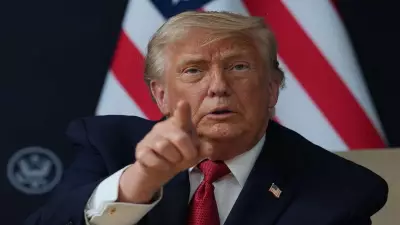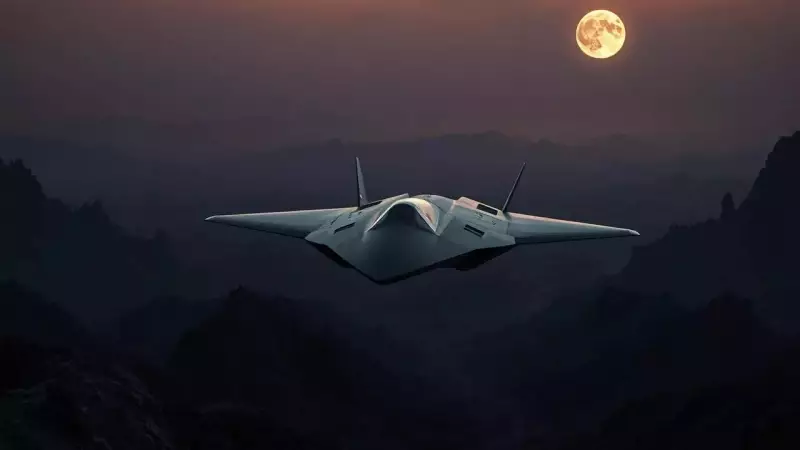
During his address at the World Economic Forum in Davos, Switzerland, former US President Donald Trump made headlines by describing the F-47 fighter jet as the "most devastating plane ever", positioning it as a new emblem of American military supremacy. However, it was the aircraft's designation that notably drew his ire, with Trump openly pondering why it was named F-47 and suggesting he might simply strip the number if he found it unsatisfactory.
Trump's Remarks on the F-47's Name and Capabilities
In his speech, Trump emphasized the superiority of US military equipment, stating, "We have the best equipment. F-35s at 47. The new one just coming out. They say it’s the most devastating plane fighter jet ever. Who knows?" He went on to express his confusion over the naming, remarking, "They called it 47. If I don’t like it, I’m going to take the 47 off it. I wonder why they called it 47, what they think about that. But if I don’t like it, I’m going to take that 47 off."
Stealth Features and Historical Comparisons
Beyond the branding debate, Trump highlighted the jet's advanced stealth credentials, referring to it as a "stage six" fighter designed to be nearly undetectable. He compared it to the B-2 bombers, which he claimed flew over Iran unseen, completed their mission, and exited without detection. "But it’s supposed to be the stage six. It’s supposed to be the first stage six plane, undetectable like our B-2 bombers were undetectable. They flew right over Iran. They were undetectable, and they did their job and they got the hell out of there," he added.

Origins and Symbolism of the F-47 Name
The designation F-47 carries significant historical and institutional weight. It traces back to the World War II-era P-47 Thunderbolt, a legendary American fighter aircraft that was later redesignated as F-47 when the US military shifted from the "P" for "Pursuit" prefix to "F" for "Fighter". This connection places the new jet within a lineage of robust, high-performance planes that shaped American air power in the mid-20th century.
Political and Institutional Meanings
The number "47" also holds deeper symbolism. It references the year 1947, when the US Air Force became an independent service branch, separating from the Army. Additionally, it nods to Donald Trump himself, as he is the 45th and 47th president of the United States. Trump had previously commented that the military chose a "beautiful number", 47, for the aircraft, adding a personal touch to its nomenclature.
Overview of the F-47 Fighter Jet
The F-47 is central to the US Air Force's Next Generation Air Dominance (NGAD) program, aimed at replacing the aging F-22 Raptor and redefining air combat strategies. Unlike traditional fighter jets, the F-47 is envisioned as a crewed aircraft that operates in tandem with autonomous drones, marking a shift towards networked, manned-unmanned warfare.
Key Features and Strategic Goals
While specific design details remain classified, the F-47 is anticipated to feature:
- Advanced stealth characteristics to evade detection
- Next-level sensors for enhanced situational awareness
- Powerful new engines for superior performance in contested airspace
NGAD is conceived as a "family of systems", with the F-47 serving as the core component in a broader combat ecosystem. The program is strategically focused on countering near-peer adversaries like China and Russia, whose air and missile capabilities have seen rapid advancements in recent years.
Trump's comments at Davos not only underscore the F-47's technological prowess but also highlight the ongoing interplay between military innovation and political branding in shaping public perception of defense assets.