

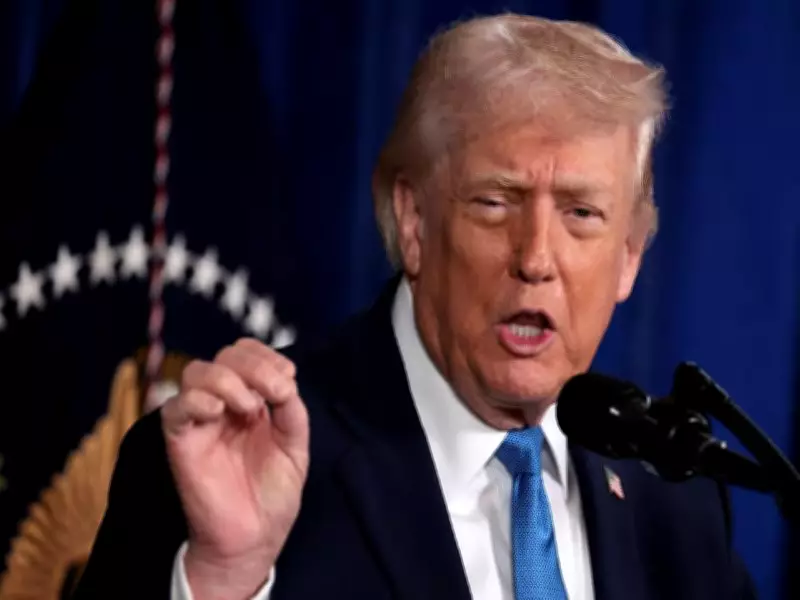
Trump Accuses Political Rivals of Undermining US Military Success in Iran
US President Donald Trump has launched a sharp critique against his political opponents, alleging they are attempting to downplay what he describes as a "great military achievement" in the ongoing conflict involving the United States, Israel, and Iran. In a recent post on his Truth Social platform, Trump asserted that "Radical Left, country-hating Democrats are trying to create inner chaos to take away from the great military achievement we are having in Iran." He further claimed that his adversaries are dissatisfied with the progress of the military campaign, stating, "They hate seeing us WIN so completely and decisively, but the American public sees what is going on. AMERICA FIRST!"
Iran's Firm Stance and Demands for Ending the War
However, this portrayal of a decisive victory is being strongly contested by Tehran. Iran has rejected an American proposal aimed at resolving the conflict, with a senior political-security official telling state broadcaster Press TV that any cessation of hostilities will only occur on Tehran's "own terms and timeline." The official emphasized Iran's determination to continue its defensive operations and inflict "heavy blows" on the enemy until its demands are met, noting that "Iran says it will end the war when it decides to do so and when its own conditions are met."
According to the official, Washington has been pursuing negotiations through various diplomatic channels, presenting proposals that Tehran views as "excessive" and disconnected from the reality of America's perceived failures on the battlefield. Consequently, Tehran has dismissed the latest overture, delivered via a friendly regional intermediary, as a tactic to escalate tensions.

Specific Conditions Outlined by Tehran
The official outlined five key conditions under which Iran would agree to end the war:
- A complete halt to "aggression and assassinations" by the enemy.
- The establishment of concrete mechanisms to ensure the war is not reimposed on the Islamic Republic.
- A guaranteed and clearly defined payment of war damages and reparations.
- The conclusion of the war across all fronts and for all resistance groups involved throughout the region.
- International recognition and guarantees regarding Iran's sovereign right to exercise authority over the Strait of Hormuz.
These stipulations are in addition to demands previously presented by Tehran during the second round of negotiations in Geneva, which took place just days before the US and Israel carried out strikes on February 28. "No negotiations will be held prior to that," the official stressed, reiterating that Iran's defensive operations will continue until all conditions are met.
US Proposals and Iranian Rejection
In response to the escalating military situation, which includes joint operations by Israel and the US targeting Iran's missile systems and critical infrastructure, the American proposal addresses maritime routes. The Strait of Hormuz, a vital artery for international oil exports, remains closed, causing a global supply contraction and pushing prices higher. Israel's Channel 12 reports that Trump's conditions include a one-month ceasefire to discuss the agreement and a total ending of Iran's nuclear weapons capability.
The American terms further demand that Tehran:
- Stop uranium enrichment within its territory.
- Ensure the Strait of Hormuz remains open.
- Transfer its stockpile of highly enriched uranium to the International Atomic Energy Agency (IAEA).
- Dismantle major nuclear sites at Natanz, Isfahan, and Fordo, while allowing full access to the IAEA.
Additionally, the US plan requires Iran to withdraw from regional proxy activities and end support for allied armed groups. Strategically, it calls for placing limits on the range and number of missiles and restricting future missile use strictly to self-defence.

Sanctions Relief Offer and Iranian Military Response
In exchange for these concessions, Washington has reportedly offered a complete lifting of sanctions on Iran and support for its civilian nuclear programme, specifically targeting power generation at the Bushehr plant. The offer also includes the removal of the 'snapback' sanctions mechanism. However, Iranian military officials have met these offers with sharp rhetoric. Lt Col Ebrahim Zolfaghari, spokesperson for the Khatam al-Anbiya Central Headquarters, stated that Trump appeared to be "negotiating with himself." He further challenged the US, remarking, "The one claiming to be a global superpower would have already gotten out of this mess if it could. Don't dress up your defeat as an agreement. Your era of empty promises has come to an end."
Conclusion: A Deepening Standoff
With Iran hardening its position and placing its own demands before the US, the standoff in West Asia appears far from over. The official highlighted the deep disconnect between the two warring parties, stating, "the end of the war will occur when Iran decides it should end, not when Trump envisions its conclusion." As military actions persist and diplomatic efforts stall, the conflict continues to pose significant challenges to regional stability and global energy markets.





