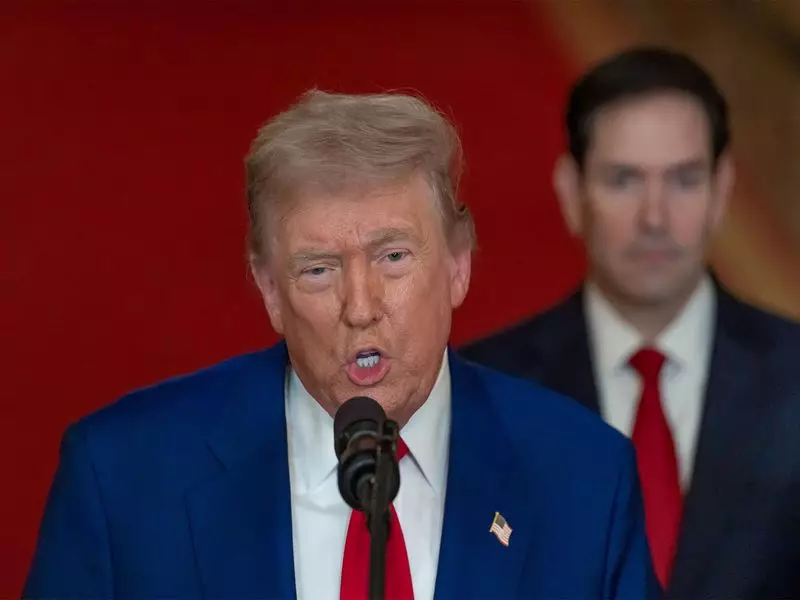
Former United States President Donald Trump has made a bold assertion regarding the state of the American economy under his potential leadership, claiming it would witness record levels of investment while domestic products would face no import tariffs.
The Core of Trump's Economic Claim
In a recent public statement, the presumptive Republican nominee for the 2024 presidential election outlined his vision for revitalizing American manufacturing and trade. Central to his argument is the promise of an economic environment where goods made within the United States are not burdened by tariffs when sold domestically. This policy stance is framed as a direct benefit to American consumers and producers, aiming to boost local industry.
Trump emphasized that his administration's previous and proposed future policies are designed to create what he calls a "boom" for domestic investment. He linked this anticipated surge in capital inflow to his tough stance on international trade, particularly with economic rivals like China. The former president suggested that a strong, protectionist trade posture actually encourages more companies to set up and expand their operations within US borders.

Context and Proposed Policy Mechanisms
The claims were made as part of a broader campaign narrative focusing on economic nationalism. Trump pointed to his first term's policies, including the imposition of significant tariffs on Chinese imports and the renegotiation of the North American Free Trade Agreement (NAFTA) into the US-Mexico-Canada Agreement (USMCA), as evidence of his approach.
For a future term, he has proposed even more aggressive measures. These include a universal baseline tariff on most foreign imports and the possibility of tariffs exceeding 60% on Chinese goods. The logic presented is that by making imported goods more expensive, American-made products become relatively more competitive, thereby stimulating local production and, consequently, investment.
He also reiterated his support for the Tax Cuts and Jobs Act of 2017, which lowered corporate tax rates, as a key driver for previous investment. The promise is to continue and expand such business-friendly policies to maintain the United States as the world's premier destination for capital.
Analysis and Potential Implications
While the promise of zero tariffs for domestic products is largely a statement of existing reality—goods produced and sold within a country typically do not face import duties—the emphasis highlights a policy focus on internal markets. The more consequential part of the claim revolves around the "record investment."
Economists are often divided on the long-term effects of high tariff walls. Proponents argue they protect nascent industries and jobs. Critics, however, warn that they can lead to trade wars, increase costs for consumers and businesses that rely on imported components, and potentially slow economic growth. The claim of spurring record investment rests on the assumption that the benefits of protectionism will outweigh these potential downsides, convincing global corporations to build factories and research centers in the US instead of elsewhere.
This economic message is strategically aimed at key voter blocs in industrial and manufacturing hubs, often referred to as the "Rust Belt," where trade and job outsourcing are sensitive issues. The vision is one of a self-sufficient industrial powerhouse, less reliant on global supply chains that have been disrupted in recent years.
As the 2024 election campaign intensifies, economic policy, including trade, tariffs, and investment, is set to be a major battleground. Trump's latest claims solidify his position as a candidate advocating for a decisive shift towards economic protectionism and national industrial policy, setting a clear contrast with the approaches of his opponents.