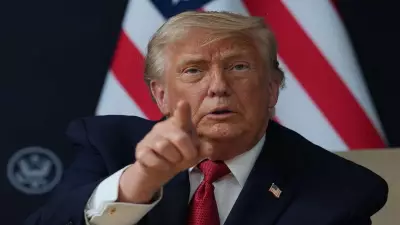
Former United States President Donald Trump issued a stark warning on Sunday, February 1, clarifying that federal authorities would refrain from intervening in protests or unrest within Democratic-governed cities unless local governments formally seek assistance. Simultaneously, he pledged a robust and forceful response to safeguard federal property from any attacks or damages.
Federal Protection of Government Assets
In an extensive post shared on his Truth Social platform, Trump revealed that he has directed Homeland Security Secretary Kristi Noem to ensure federal agencies act with aggression and determination whenever federal buildings become targets. "Under no circumstances are we going to participate in various poorly run Democrat Cities with regard to their Protests and/or Riots unless, and until, they ask us for help," Trump emphasized in his statement.
However, the former president made it clear that federal authorities would not hesitate to take decisive action to defend critical infrastructure. "We will, however, guard, and very powerfully so, any and all Federal Buildings that are being attacked by these highly paid Lunatics, Agitators, and Insurrectionists," he asserted, underscoring a zero-tolerance policy towards violence directed at government property.

Instructions to Immigration and Border Agencies
Trump further elaborated that Immigration and Customs Enforcement (ICE) and the US Border Patrol have been instructed to adopt a "very forceful" stance in protecting federal government assets. He issued a stern warning against any form of aggression towards law enforcement officers, stating, "There will be no spitting in the faces of our Officers… and there will be no rock or brick throwing at our vehicles." Violators, he cautioned, would face "equal, or more, consequence" for their actions.
Reference to Oregon Incident and Local Responsibilities
Citing a specific incident in Eugene, Oregon, Trump highlighted an episode where protesters allegedly broke into a federal building and inflicted significant damage. "Last night in Eugene, Oregon, these criminals broke into a Federal Building, and did great damage… Local Police did nothing in order to stop it. We will not let that happen anymore!" he wrote, reinforcing his commitment to preventing such occurrences in the future.
The former president delineated responsibilities clearly, noting that protecting state and local property remains the primary duty of governors and mayors. Federal authorities, he explained, would serve as a backup force, stepping in only when local capabilities are overwhelmed. "You must protect your own State and Local Property… It is your obligation to also protect our Federal Property," Trump stated, outlining the expected cooperation between different levels of government.
Formal Request Requirement and Military Deployment Possibility
Trump set a specific condition for federal intervention, warning that if local governments are unable to control unrest, federal forces would assist—but solely after receiving a formal request. "Let us know when you are ready, and we will be there — But, before we do so, you must use the word, 'PLEASE,'" he wrote, emphasizing the necessity of a respectful appeal for help.
Additionally, Trump raised the possibility of deploying the military if deemed necessary. "ICE, Border Patrol or, if necessary, our Military, will be extremely powerful and tough in the protection of our Federal Property," he declared, indicating a readiness to escalate responses to ensure security.
Context of Minnesota Protests and Local Pushback
These remarks emerge against a backdrop of weeks-long protests and unrest, particularly following the deployment of thousands of federal immigration officers to Minnesota. This move has sparked confrontations between agents and demonstrators in cities like Minneapolis, fueling tensions and widespread public outcry.
Trump defended his approach as integral to his presidential legacy, asserting, "I was elected on a Policy of Border Control, National Security, and LAW AND ORDER — That’s what America wants, and that’s what America is getting!" He positioned his stance as a fulfillment of campaign promises centered on security and order.

However, local officials in several Democratic-led cities have consistently challenged Trump's assertions that federal intervention is essential. They argue that such deployments often exacerbate tensions rather than restore calm, creating a cycle of conflict instead of resolution.
Ongoing Unrest and Legal Developments
The statement coincides with sustained unrest triggered by a significant deployment of Border Patrol and ICE agents to Minnesota, coupled with the fatal shootings of two US citizens, Renee Good and Alex Pretti, by federal agents who cited responding to threats as justification. Thousands of protesters marched in Minneapolis and other cities on Friday, demanding the withdrawal of federal immigration agencies from the state. Activists have also engaged in efforts to monitor and track immigration enforcement activities within local communities.
As part of an immigration crackdown, the Trump administration has deployed approximately 3,000 federal officers to the Minneapolis area, leading to repeated clashes between agents and demonstrators. In response, Minnesota officials have urged the administration to terminate the federal operation, contending it has heightened tensions unnecessarily.
On January 31, a federal judge rejected a request from state officials, including Attorney General Keith Ellison, for a preliminary injunction that would have halted the deployment. This legal decision underscores the ongoing debate over federal versus local authority in managing public unrest and security measures.