

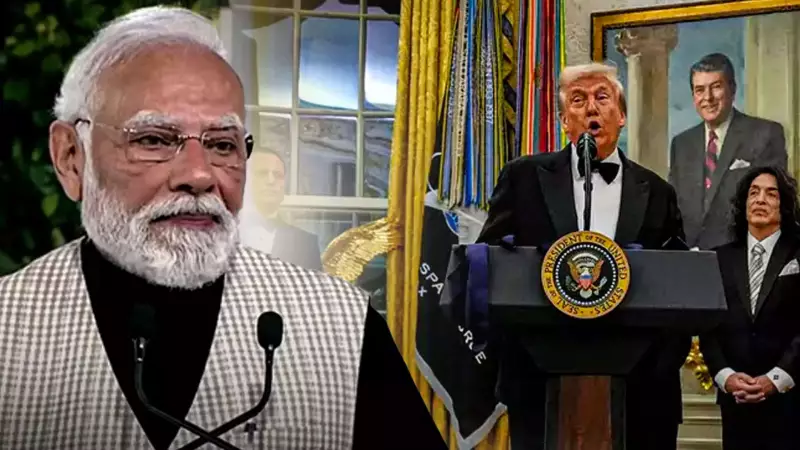
In a striking assertion that has reignited a complex debate, former US President Donald Trump has directly linked his administration's aggressive tariff agenda to de-escalating military tensions between India and Pakistan. Trump made these comments while defending his trade policies during an appearance at the Kennedy Center Honours event in Washington DC on December 8, 2025.
Trump's Geopolitical Justification for Tariffs
President Trump argued that imposing tariffs provides the United States with vital leverage for national security, extending beyond economics into the realm of conflict prevention. He specifically cited the simmering tensions between India and Pakistan as a case where his administration's trade measures played a role in averting a major confrontation. This is not the first time Trump has drawn this comparison, but his renewed comments come at a politically sensitive juncture.
The timing is crucial, as the US Supreme Court is poised to rule on the legality of Trump's actions. The court is examining whether the President overstepped his legal authority by invoking emergency powers to enforce broad-spectrum tariffs during his second term. Since January, his administration has reinstated significant import duties on multiple trading partners, a move that economic analysts say has contributed to rising prices for essential goods in the US market.

Legal Scrutiny and Economic Impact
The core legal question revolves around the extent of presidential power. Trump's use of emergency declarations to implement tariffs, bypassing standard congressional oversight, is now under the microscope of the highest court. A ruling against the administration could curtail this executive tool and force a rollback of the contested trade barriers.
Economically, the policy has had tangible effects. The reinstated duties have made a range of imported products more expensive, impacting American consumers and businesses. Trump's defense, however, pivots from pure economics to a broader doctrine of "peace through strength" in trade, suggesting that financial pressure is a powerful, non-kinetic tool for global stability.
Reactions and the Road Ahead
Trump's latest invocation of the India-Pakistan dynamic has sparked fresh criticism and analysis. Experts on South Asian geopolitics have often been skeptical of such claims, noting that regional standoffs are influenced by a multitude of complex historical and diplomatic factors beyond US trade policy. Critics argue that tying specific trade actions to delicate nuclear-tinged diplomacy is an oversimplification that could itself create unintended risks.
The debate now unfolds on two parallel tracks: one in the court of law and another in the court of public and international opinion. The Supreme Court's impending decision will directly affect the future of Trump's tariff architecture. Simultaneously, his comments ensure that the conversation about using trade as a geopolitical weapon will remain at the forefront of discussions on US foreign policy and its implications for partners like India.
As the world watches the judicial outcome, the episode underscores the increasingly intertwined nature of global trade, security, and diplomacy in the modern era.






