

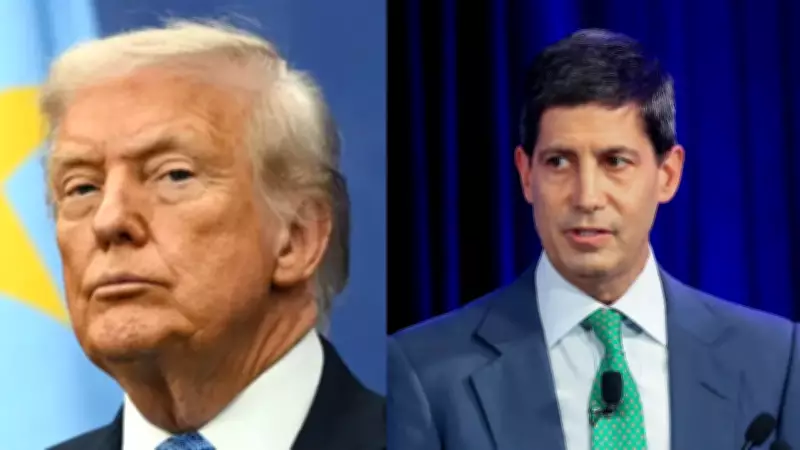
Trump Expresses Disappointment Over Potential Lack of Rate Cuts from Fed Nominee
In a revealing interview with CNBC's "Squawk Box" on Tuesday, former US President Donald Trump stated he would be disappointed if his nominee for Federal Reserve chair, Kevin Warsh, does not implement interest rate cuts immediately after taking office, assuming Senate confirmation. Trump's comments highlight the ongoing tension between political expectations and central bank independence.
Warsh Emphasizes Independence Amid Political Pressure
During his Senate Banking Committee confirmation hearings, Kevin Warsh, a former Federal Reserve official and financier, firmly asserted his commitment to independence from political influence. "The president never once asked me to commit to any particular interest rate decision, and nor would I agree to it if he had," Warsh testified, as reported by the LA Times. He added, "I will be an independent actor if confirmed as chair of the Federal Reserve."
Warsh outlined his priorities, stating that combating inflation would be a central focus if he assumes the role. "Congress tasked the Fed with the mission to ensure price stability, without excuse or equivocation, argument or anguish," he told lawmakers. "Inflation is a choice, and the Fed must take responsibility for it."

Inflation and Global Tensions Complicate Rate Decisions
The confirmation hearings occur against a backdrop of significant economic challenges. Inflation remains elevated at 3.3% annually, while global tensions, including conflicts in regions like Iran, are driving up gas prices and adding pressure to the economy. Typically, higher inflation prompts the Federal Reserve to maintain or increase interest rates to curb spending and borrowing, rather than cutting them.
Rate changes have far-reaching effects, influencing mortgages, auto loans, and business borrowing costs. Investors are closely monitoring Warsh's hearings, as his stance could shape monetary policy in a volatile economic environment.
Political Dynamics and Historical Context
Democrats on the Senate Banking Committee have accused Warsh of shifting his position on interest rates over time, alleging he supported higher rates under Democratic administrations and lower rates during Trump's presidency. This criticism underscores the partisan scrutiny surrounding his nomination.
If confirmed, Warsh would take leadership of the Federal Reserve at a complex juncture where inflation pressures make rate cuts difficult, despite Trump's persistent advocacy for lower borrowing costs. Trump has repeatedly clashed with current Fed Chair Jerome Powell over monetary policy, urging faster rate reductions.
Notably, Powell has faced a Department of Justice criminal probe after resisting Trump's demands for accelerated rate cuts. In his CNBC interview, Trump indicated he does not intend to pressure the Justice Department to halt that investigation, adding another layer to the ongoing narrative of political interference in central banking.
The situation highlights the delicate balance between presidential expectations and the Federal Reserve's mandated independence, with Warsh's confirmation poised to test these boundaries in an era of economic uncertainty.






