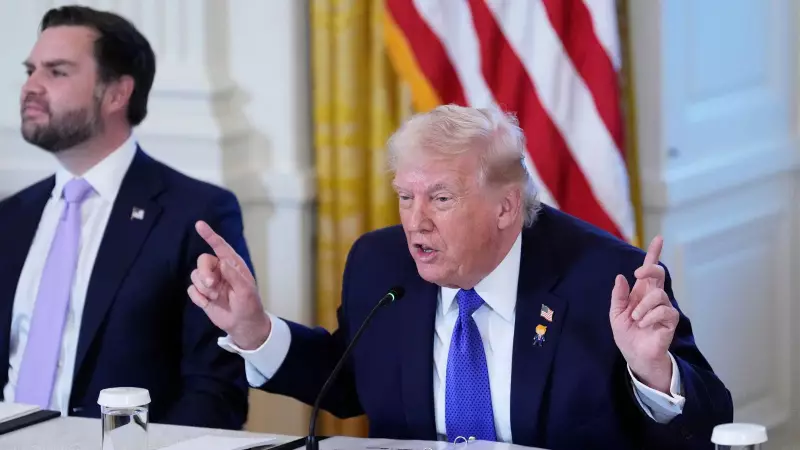
Former United States President Donald Trump has issued a direct and public warning to Iran's leadership, signalling a potential US response as the nation grapples with internal protests and a widespread internet shutdown. The warning comes amidst a period of significant political uncertainty in Iran following the tragic death of President Ebrahim Raisi in a helicopter crash.
Trump's Stern Warning and the Context of Unrest
In a post on his social media platform, Truth Social, Donald Trump delivered a blunt message aimed at Tehran. He stated, "The horrible helicopter crash of the President of Iran, Ebrahim Raisi, was a terrible thing to watch." However, he quickly pivoted to a cautionary note, adding, "The bigger terrible thing is what Iran represents, and what it has done to America over the years." Trump concluded with a stark warning: "They better be careful because the United States of America is no longer the country it was four years ago, when I was President!"
This statement is widely interpreted as a signal that a potential Trump administration, should he win the upcoming November election, could adopt a far more aggressive stance towards Iran compared to the current Biden administration. The warning coincides with a volatile situation inside Iran. Public protests have reportedly erupted in several regions, including the province of South Khorasan, with citizens expressing anger and dissatisfaction. The catalyst for these demonstrations appears to be the helicopter crash that killed President Raisi, Foreign Minister Hossein Amir-Abdollahian, and other officials on May 19.

Internet Blackout and Escalating Domestic Tensions
In a move seen as an attempt to control the narrative and suppress dissent, Iranian authorities have imposed a severe internet shutdown. Reports from internet monitoring groups like NetBlocks confirm a "near-total internet shutdown" affecting mobile networks and significant disruptions to fixed-line services. This blackout severely limits the flow of information both within Iran and to the outside world, a tactic previously used by the regime during periods of civil unrest.
The domestic reaction to Raisi's death is complex. While official state media portrays a nation in mourning, underground social media channels and reports from activist groups tell a different story. Videos circulating online show some citizens publicly celebrating the death of Raisi, a hardline figure known for his role in the judiciary and human rights record. This public defiance, coupled with the protests, underscores the deep-seated political and social fissures within Iranian society.
Geopolitical Ramifications and the Path Forward
The convergence of internal instability and external warnings from a key US political figure creates a precarious geopolitical moment. Trump's message serves as a reminder of the fraught history between the two nations and the potential for rapid escalation. His administration previously withdrew from the Iran nuclear deal (JCPOA) and pursued a "maximum pressure" campaign of sanctions.
The immediate focus within Iran is on political succession. According to the Iranian constitution, First Vice President Mohammad Mokhber has assumed interim presidential duties. A new presidential election has been scheduled for June 28, setting the stage for a potentially contentious political transition. How the ruling establishment manages this transition, the public protests, and the external pressure will be critical in determining Iran's short-term stability.
For the international community, and particularly for the current US administration, the situation presents a delicate challenge. Balancing monitoring of Iran's internal affairs, responding to any regional provocations, and navigating the electoral rhetoric from political opponents like Trump requires careful diplomacy. The world now watches closely to see if Iran's internal pressures boil over further and how the United States, both in its current and potential future form, chooses to respond.