

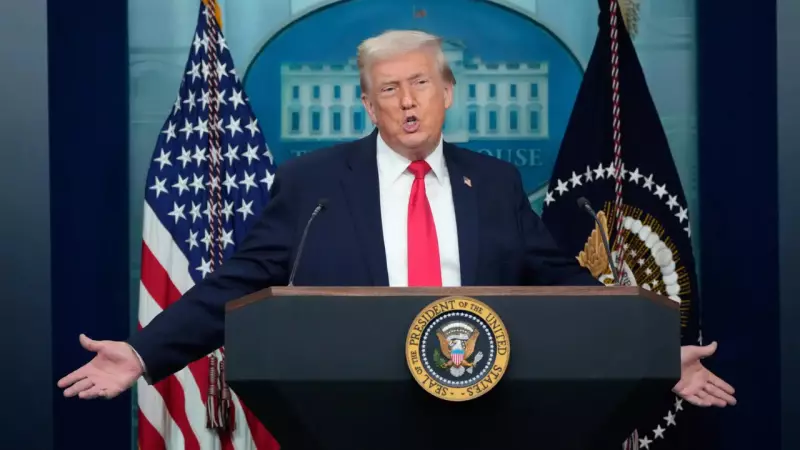
In a development that adds to the already heightened tensions in the Middle East, US President Donald Trump has publicly stated that another American "armada" is currently moving toward Iran. Speaking at a public event in Iowa, Trump expressed hope that Tehran would agree to a deal with Washington, though he did not specify the exact composition or purpose of this naval force.
Trump's Remarks on Naval Movements
During his address, Trump remarked, "By the way, there's another beautiful armada floating toward Iran right now. So we'll see. I hope they make a deal. I hope they make a deal." It remains unclear whether he was referring to the USS Abraham Lincoln aircraft carrier strike group, which arrived in the region earlier this week, or to another set of US warships being deployed. This statement comes amid increased US military activity in the area, with Trump previously describing the situation with Iran as "in flux" and noting he had sent a "big armada" while believing Tehran genuinely wants to negotiate.
Diplomatic Options and Military Posturing
Trump has kept the door open for talks, telling Axios that diplomacy remains an option and asserting, "They want to make a deal. I know so. They called on numerous occasions." However, US officials have indicated that military options are still on the table, with additional naval, air, and defence assets being moved into the region. This dual approach of diplomacy and military pressure underscores the complex dynamics at play.

Iran's Strong Response to US Build-up
In response to the US military build-up, Iranian authorities have issued sharp warnings. Mohammad Akbarzadeh, political deputy of the Islamic Revolutionary Guard Corps (IRGC) naval forces, stated that neighbouring countries would be considered hostile if their territory was used to launch an attack against Iran. He was quoted by the Fars news agency as saying, "Neighbouring countries are our friends, but if their soil, sky, or waters are used against Iran, they will be considered hostile."
Regional Stability and Saudi Arabia's Stance
Iranian President Masoud Pezeshkian has also warned that US "threats" would only destabilise the region, particularly as Washington has not ruled out military action over Iran's crackdown on protests. Meanwhile, Saudi Arabia has declared it will not allow its airspace or territory to be used for any attack on Iran, according to reports from AFP. This stance highlights the delicate balance in the region, where alliances and hostilities are closely intertwined.
Fragile Standoff and Potential Consequences
The current standoff between the US and Iran remains fragile and volatile. Iranian officials have repeatedly warned that any attack would be met with a strong response, emphasising the high stakes involved. As both sides navigate this tense situation, the world watches closely, aware that any miscalculation could lead to significant escalation in an already unstable part of the globe.






