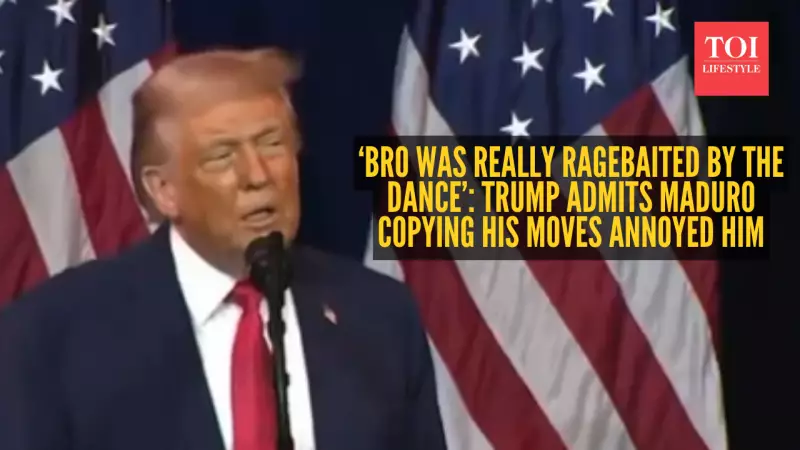
In a startling revelation that blends personal pique with high-stakes geopolitics, former United States President Donald Trump has publicly confessed that his decision to pursue former Venezuelan President Nicolás Maduro was partly fueled by an unusual grievance: Maduro copying his trademark dance moves. The admission came during a lengthy speech Trump delivered to Republicans at the Kennedy Center on Tuesday, adding a surreal layer to an international prosecution that could end in the death penalty.
Trump's Personal Grievance Takes Center Stage
Addressing his supporters, Trump mocked Maduro, who is now in U.S. custody, directly accusing him of imitation. "He's a violent guy," Trump stated. "He gets up there, and he tries to imitate my dance a little bit," he added, before repeating, "But he's a violent guy." This focus on perceived mockery rather than purely political or criminal charges immediately ignited a firestorm of reactions online. Many social media users labeled Trump's frustration as bizarre and thin-skinned, with one commenting, "Bro was really ragebaited by the dance."
However, this was not an isolated outburst. Earlier reports, including from The New York Times, suggested that Maduro's public behavior had become a serious irritant for the Trump administration. Insiders claimed that Maduro's singing and dancing in the weeks leading up to his capture were viewed as deliberate provocations, an attempt to call what he believed was the administration's bluff. The final straw reportedly came during the opening ceremony of the International School for Women's Leadership in December, where Maduro appeared to mimic Trump's well-known fist-pumping stance.

Maduro's Defiant Performance Before the Fall
In the months before his dramatic capture, Nicolás Maduro had increasingly used performance as a tool of political defiance. He was filmed dancing to an electronic remix of his own speech, "No War, Yes Peace," alongside his wife Cilia Flores, who was also later extradited. Singing became a recurring feature at his appearances; in November, he performed John Lennon's 'Imagine', invoking it as a message of peace. "Do everything for peace, as John Lennon used to say, right?" Maduro told a crowd, framing the song as an anthem for humanity.
This defiance reportedly persisted even in the immediate aftermath of his capture by U.S. forces. As he was shackled and escorted by Drug Enforcement Administration (DEA) agents to a high-security prison on Saturday, Maduro wished them a "Happy New Year." However, by Monday, his bravado seemed to have faded. Photographs from his court appearance showed the 63-year-old limping, dressed in a greige prison jumpsuit, shackles, and handcuffs, struggling as federal agents led him to a vehicle.
From Dance Floor to Courtroom: The Legal Reckoning
The surreal personal grievance over dance moves now underpins a grave legal battle. Maduro has been arraigned on multiple serious charges, including narcoterrorism. Several of these charges carry the potential for the death penalty. What began with imitated gestures on a public stage is now destined to play out in the sober setting of a U.S. courtroom. The episode highlights how personal dynamics between leaders can inflame already tense international relations, transforming diplomatic strategy into a deeply personal conflict.
Trump's candid admission has undoubtedly shaped the narrative around Maduro's prosecution, raising questions about the motivations behind one of the most significant international arrests in recent years. While the legal charges are substantial, the revelation of a slight over dance moves ensures this case will be remembered for its unprecedented and peculiar origins.