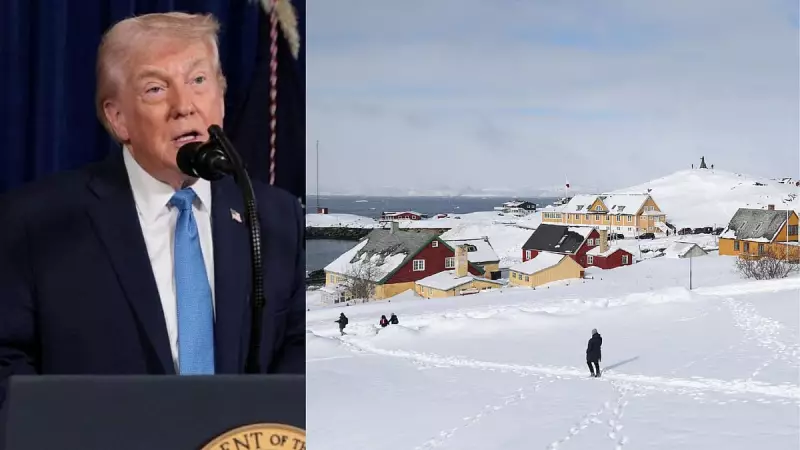
Former US President Donald Trump has once again brought global attention to the Arctic by reiterating his interest in the potential annexation of Greenland. This renewed statement comes at a time when the United States' military posture in regions like Venezuela has already heightened international tensions. The idea, first floated during his presidency, underscores a long-standing geopolitical calculation about the island's immense strategic value.
The Geopolitical Chessboard: Why Greenland Matters to the US
Greenland, the world's largest island, is an autonomous territory within the Kingdom of Denmark. For decades, its location has been viewed by American strategists as a critical asset. Trump has explicitly stated, 'We need Greenland from the standpoint of national security.' This perspective is rooted in the island's position between the North Atlantic and Arctic Ocean, which serves as a vital corridor for military and commercial navigation.
The United States already maintains a significant military presence at Thule Air Base in northern Greenland. This base is a key node in America's missile warning and space surveillance network. However, control over the entire island would offer unparalleled advantages. It would allow the US to project power more effectively across the Arctic, a region becoming increasingly accessible and contested due to climate change. Furthermore, it would counter the growing influence of other global powers like Russia and China in the High North.

Historical Context and Recent Developments
The notion of the US acquiring Greenland is not new; it dates back to 1946 when President Harry S. Truman offered to buy it from Denmark for $100 million. The recent revival of this idea by Trump, reported on 06 January 2026, has reignited a complex diplomatic discussion. The timing is particularly sensitive, coinciding with renewed fears about US military interventions, as seen in Venezuela.
For Denmark, Greenland is a sovereign matter. The Danish government and the local Greenlandic administration have consistently and firmly rejected any notion of a sale or transfer of sovereignty. They view Trump's comments as dismissive of Greenland's right to self-determination and Denmark's constitutional authority. The proposal has, predictably, caused diplomatic friction between the two NATO allies.
Broader Implications and Future Scenarios
The persistent interest in Greenland signals a broader shift in US foreign policy towards securing tangible strategic assets. The potential consequences are multifaceted:
- Arctic Militarization: A US move on Greenland could accelerate a new arms race in the Arctic, prompting Russia and others to bolster their own military capabilities in the region.
- Alliance Strain: It tests the resilience of the transatlantic alliance, forcing European partners to choose between supporting Denmark and acquiescing to US strategic demands.
- Resource Competition: Beyond military strategy, Greenland is believed to hold vast deposits of rare earth minerals and hydrocarbons, making it a prize in the global resource competition.
While an actual annexation remains a highly improbable scenario due to political and legal hurdles, Trump's repeated articulation of the desire keeps the issue alive. It serves as a reminder of how great powers continue to view geography as a fundamental element of security strategy. The episode underscores that even in the 21st century, territorial control in remote regions like Greenland is a cornerstone of geopolitical ambition for nations like the United States.