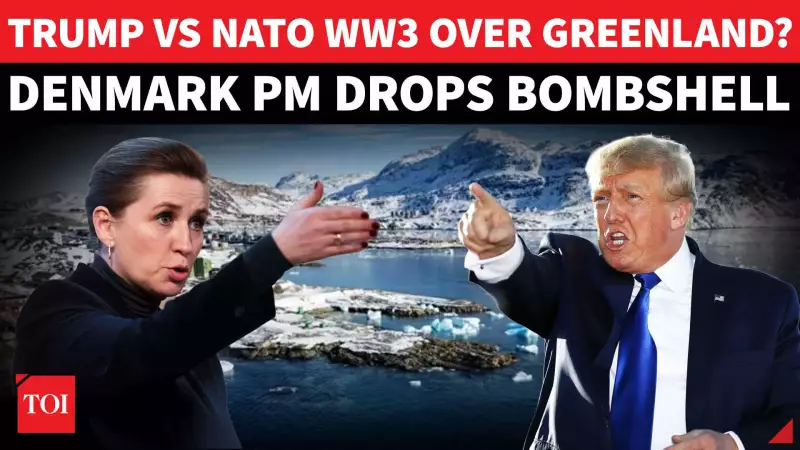
The geopolitical landscape of the Arctic has been thrown into turmoil following a stark declaration from former US President Donald Trump regarding Greenland. This has prompted a firm response from Denmark's Prime Minister Mette Frederiksen, who has labelled the situation a "decisive moment" for Europe. The escalating tension has forced the North Atlantic Treaty Organization (NATO) to prepare its military forces, raising fears of an unprecedented confrontation within the alliance.
A Historic Threat Resurfaces: America's Claim on Greenland
At the heart of the crisis is Trump's renewed assertion of American interest in acquiring Greenland, the world's largest island, which is an autonomous territory within the Kingdom of Denmark. Reports from January 12, 2026, indicate that Trump has explicitly stated that the United States needs Greenland for its strategic security, bluntly adding that Washington would secure it "by force if needed". This revival of a historical acquisition idea, which first surfaced during Trump's previous presidency, has shifted from speculative geopolitics to a direct and urgent threat.
Trump's rationale hinges on Greenland's immense strategic value in the Arctic, a region becoming increasingly crucial for global power competition due to its:

- Vast untapped natural resources.
- Key shipping routes emerging from melting ice.
- Critical importance for missile defence and military surveillance.
Nordic Solidarity and NATO's Dilemma
In response, Denmark has drawn a hard line. Prime Minister Mette Frederiksen's statement underscores the gravity with which Copenhagen views the threat to its sovereign territory. The Nordic nations have swiftly rallied behind Denmark, presenting a united front against what they perceive as aggressive US pressure. This creates a profound crisis for NATO, an alliance built on collective defence, now facing the spectre of a major conflict between two of its own members.
The alliance is now in the precarious position of "readying" its troops, as per reports, potentially for a deployment to the Arctic island. This move is ostensibly to ensure stability but highlights the severe fracture within the bloc. The situation presents a classic security dilemma: actions meant to deter one party may inadvertently escalate hostilities with another.
Global Repercussions and a New Battleground
The implications extend far beyond the North Atlantic. The standoff has effectively transformed Greenland into the world's newest geopolitical battleground, where issues of Arctic security, great power ambition, and the future of Western alliances violently collide. Global observers are watching closely, as the outcome could redefine international norms on sovereignty and the use of force among allies.
This crisis tests the very foundation of the post-World War II international order. A forceful US takeover of Greenland would represent an unprecedented act against a NATO ally, potentially shattering the alliance. Conversely, a backing down could be seen as a weakening of American resolve. The "decisive moment" described by PM Frederiksen is not just for Europe, but for the entire framework of global security, setting a precedent that will resonate in conflicts and diplomatic negotiations for decades to come.